Free guide · For APOE4 carriers
Sleep quality changes what the gene does to your risk.
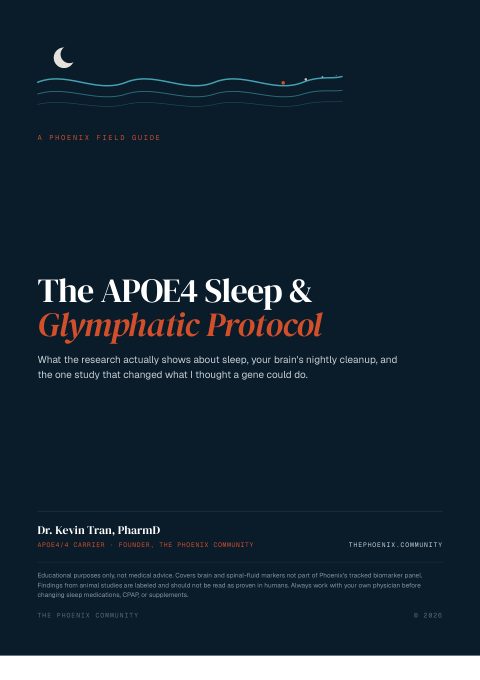
You have heard sleep is good for your brain. Here is the sharper finding: in one study, better sleep consolidation attenuated the effect of the APOE4 allele on Alzheimer’s risk. Not that carriers sleep worse. That sleep quality changes what the gene appears to do. This free guide walks through the glymphatic wash cycle, the apnea most women never get diagnosed with, and the single best-supported lever in the whole literature, sorted honestly by how strong the evidence actually is.
The PDF lands in your inbox in seconds. No spam, only the APOE4 research you’d actually want to hear about.
20–48%
lower mortality risk
n=60,977, UK Biobank
21 pages · PubMed-cited
The finding almost nobody frames honestly
It is not “carriers sleep worse.” It is sharper than that.
Most sleep advice treats sleep as generically good for you, like vegetables or sunshine. One study did something more specific, and the honest version of it is more useful than the exciting one.
- One cohort, read carefully
Better sleep, blunted gene effect
In 698 older adults, better sleep consolidation attenuated the ε4 allele’s effect on Alzheimer’s risk and on tangle density in a post-mortem subgroup. Carrier and non-carrier sleep did not differ at baseline.
- Mechanism vs proof
The wash cycle is real, mostly in mice
The glymphatic system clearing amyloid during sleep is elegant, foundational biology. The headline numbers come from live mice. Two small human studies found real, indirect signals of the same story.
Regularity beat duration head to head.
Reference riskRange across the study’s estimates
What’s inside
Sorted honestly, by the strength of the evidence.
Every claim is PubMed-cited, sample sizes included, animal studies clearly labeled.
- 01
The study that reframed the gene
Why “sleep is good for you” undersells what one study found about your genotype.
The spine - 02
The brain’s nightly wash cycle
The glymphatic mechanism, and why the headline numbers are still mice.
Mechanism - 03
What one bad night does
The small but real human PET and cerebrospinal-fluid evidence.
Human data - 04
The apnea most women miss
Up to 75% go undiagnosed, and the honest limit of what CPAP proves.
The gap - 05
How much sleep is enough
The U-shaped curve, and where two meta-analyses land, and disagree.
Duration - 06
The single best predictor
What a 60,977-person study found matters more than hours slept.
The lever
And what is oversold
Melatonin, sleeping pills, side-sleeping. Read the label closely.
The guide gives melatonin, sleeping pills, and the sleep-on-your-side theory the same honest treatment as everything else: what the trials actually found, not what sounds reassuring.
The unglamorous stuff, a steady bedtime, treating diagnosed apnea, drinking less before bed, sits on the strongest science. The stuff that sounds like a breakthrough sits on the thinnest.From the guide · the protocol, ranked by the evidence

Why I built this
“For three months I woke up at two or three in the morning, every night. I am a Doctor of Pharmacy. I could not just decide my way into sleeping through it. This guide asks a lot of the evidence and very little of you. No forty-supplement stack, just what the research says, and what it does not.”
Dr. Kevin Tran · Doctor of Pharmacy · APOE4/4 carrier · Founder
Read my storyYou don’t have to track it alone
Turn the protocol into a habit you can see.
Inside Phoenix, sleep is one more number you track against APOE4-aware context, alongside a pod of carriers doing the same thing.
Your pod
Matched to fellow APOE4 carriers, so a habit as personal as sleep does not have to happen alone.
Sleep tracking that speaks APOE4
Log your nights, sync data from Oura or Apple Health, and see your own regularity pattern instead of guessing.
Bloodwork that speaks APOE4
Track 27 APOE4-aware biomarkers against carrier-specific targets, not generic “normal.”
A community that did the homework
Hundreds of carriers who have had the exact apnea, medication, and regularity conversations in this guide.
Common questions
Frequently asked questions.
Does sleep actually change what the APOE4 gene does to my risk?
One study found it might. In a cohort of 698 older adults, better sleep consolidation attenuated the effect of the APOE4 allele on Alzheimer’s risk (hazard ratio 0.67 per one-SD improvement) and on tangle pathology in a post-mortem subgroup. This is one cohort, not yet independently replicated, and the same study found carrier and non-carrier sleep did not differ at baseline, so it is not evidence that carriers sleep worse.
Is the brain’s overnight "wash cycle" proven in humans?
The mechanism (the glymphatic system clearing amyloid-beta during sleep) is elegant, well-established science, but the foundational 60% and twofold-clearance figures come from live mice, not people. Two smaller human studies (n=20 and n=17) found real but indirect evidence: one night of sleep deprivation raised amyloid in the human brain, and disrupting deep sleep specifically raised cerebrospinal-fluid amyloid.
Why is sleep apnea singled out as the most under-treated lever?
Because up to 75% of women with obstructive sleep apnea go undiagnosed, since the disorder often presents as fatigue, insomnia, or mood changes rather than the loud-snoring picture apnea screening was built around. Apnea severity tracks with rising amyloid over a 2-year cohort. The guide is also honest that randomized trials of CPAP have not shown a clinically significant cognitive benefit.
How many hours of sleep is actually enough?
Two large meta-analyses agree on a U-shaped risk curve, both too little and too much sleep track with higher cognitive decline risk, but they disagree slightly on the exact best number, somewhere close to 7 hours. The guide gives you both studies and the honest range rather than a single manufactured number.
What is the single most actionable finding in the guide?
Sleep regularity, not duration. In a UK Biobank study of 60,977 people tracked with wrist accelerometers, sleep regularity predicted mortality risk more strongly than sleep duration did, and the most consistent sleepers had 20 to 48% lower all-cause mortality. It costs nothing and needs no gadget.
Get the free guide
Sleep is a lever. Pull the ones that are proven.
Enter your email and we’ll send the APOE4 Sleep & Glymphatic Protocol straight to your inbox, plus the research and member experiments we publish each week.
Straight to your inbox. No spam, only APOE4 research worth your time, and you can leave with one click.
This guide is educational and not medical advice. It covers brain and spinal-fluid research markers not part of Phoenix’s tracked biomarker panel. Several human studies cited are small; animal studies are labeled and are not proof of the same effect in people. Always work with your own physician before changing sleep medications, CPAP therapy, or supplements.
Daily protocol
More free guides.
 The APOE4 Diet PlaybookCompare dietary approaches and plan what goes on your plate.
 The APOE4 Exercise ProtocolExplore aerobic exercise, higher-intensity sessions and strength training.
 The APOE4 Inflammation, Gut & Stress GuideExplore the research and questions about what to measure.
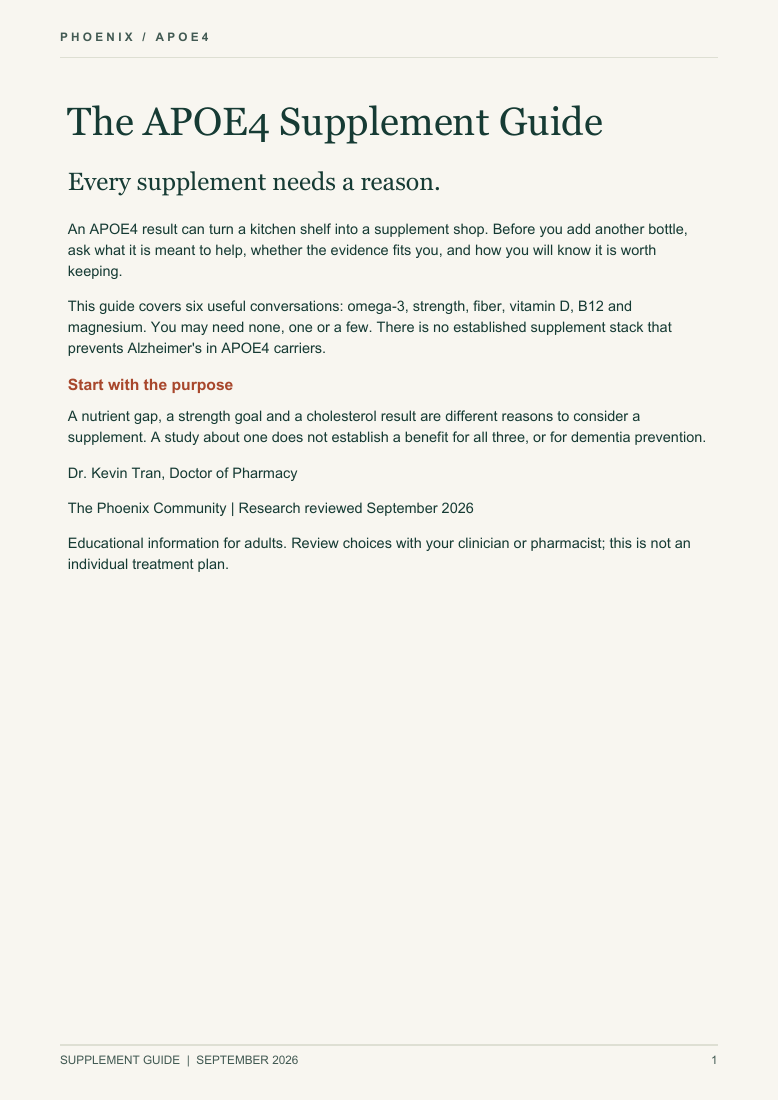 The APOE4 Supplement GuideCompare supplement evidence and questions to ask before buying.
Phoenix APOE4 ResearchClinical trial engineAPOE4 doctor directory