Free guide · For APOE4 carriers
Your gene runs your immune system hotter, and that changes what inflammation does to your risk.
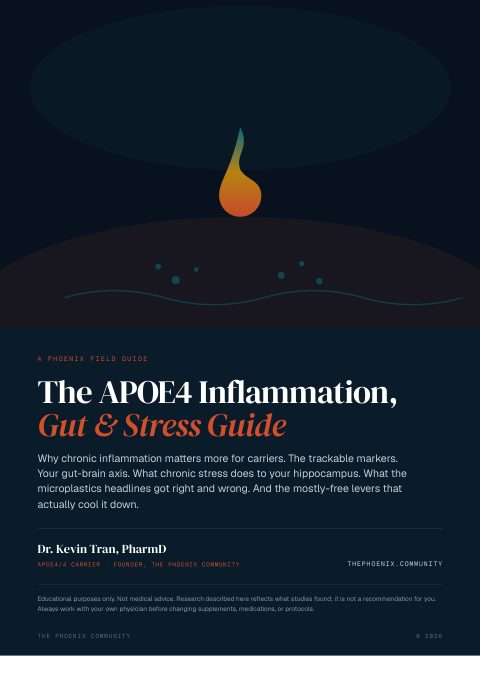
You have heard inflammation is bad for your brain. Here is the sharper finding: in a 17-year Framingham Heart Study analysis, APOE4 carriers with chronically high CRP carried a dramatically higher Alzheimer’s risk, a pattern that did not even show up in people without the gene. Not that carriers are more inflamed. That inflammation counts for more once you carry the gene. This free guide walks through why your immune system runs hotter, the gut bacteria that talk straight to your brain, what chronic stress does to a brain structure called the hippocampus, and the practical, mostly free things that turn the fire down.
The PDF lands in your inbox in seconds. No spam, only the APOE4 research you’d actually want to hear about.
~40%
higher MCI risk, top decile
n=1,256, 12-yr cohort
17 pages · PubMed-cited
The finding almost nobody frames honestly
It is not “inflammation is bad for everyone.” It is sharper than that.
Most advice treats inflammation as generically bad, like stress or sugar. The APOE4 literature does something more specific, and the honest version of it is more useful than the vague one.
- One 17-year cohort, read carefully
Chronically high CRP, chronically higher risk
In the Framingham Heart Study, carriers with chronically high CRP had a dramatically higher risk of Alzheimer’s, a pattern that did not show up in people without the E4 allele. Your genotype and your inflammation appear to interact.
- Mechanism vs blame
The immune crew that will not stand down
APOE4 disrupts the brain’s resident immune cells, tipping them toward chronic, unresolved inflammation, one of the most consistent threads in the whole APOE4 literature. Your genotype sets a baseline. This is biology, not blame.
The least and most distressed adults were not close.
What’s inside
Every page, sorted honestly by the strength of the evidence.
Every claim is PubMed-cited, sample sizes included, human and animal studies clearly labeled.
- 01
Why APOE4 runs hot
How your genotype changes the behavior of microglia, the brain’s resident immune cells.
The mechanism - 02
hs-CRP and IL-6, the trackable fire
The two blood numbers that put a figure on inflammation you cannot otherwise feel.
The trackable fire - 03
Your gut is talking to your brain
The gut-brain axis, the leaky-gut chain, and the APOE4-specific microbiome finding.
The gut angle - 04
Stress, cortisol, and your hippocampus
What chronic stress actually does to a brain structure you can measure on an MRI.
The stress lever - 05
The levers, in order
Five free levers come before the one lever, supplements, that costs real money.
The order - 06
What to test and target
The exact panel to bring to your doctor, and where APOE4-aware targets aim.
The panel
And what the headlines got wrong
The “spoonful of plastic in your brain.” Read past the headline.
The guide gives the microplastics panic in your feed the same honest treatment as everything else: brain tissue really does carry more plastic than other organs, and the “spoonful” figure and the dementia-causation claim do not hold up under a closer read.
The five free levers, diet, fiber, sleep, stress, and exercise, carry almost all of the proven benefit. Supplements are the cherry, not the cake, and they go last.From the guide · the levers, in order

Why I built this
“For years I only tracked my cholesterol. I never thought to ask about the two blood tests, hs-CRP and IL-6, that put a number on the fire running quietly in the background of my own immune system. As a Doctor of Pharmacy who also carries two copies of this gene, I do not like guessing at what I can measure. I built this guide, then Phoenix, because a feeling is not a number, and I wanted the number.”
Dr. Kevin Tran · Doctor of Pharmacy · APOE4/4 carrier · Founder
Read my storyYou don’t have to track it alone
Turn the fire down with numbers you can actually see.
Inside Phoenix, hs-CRP and ApoB are two more numbers you track against APOE4-aware targets, alongside a pod of carriers doing the same thing.
Your pod
A small group of fellow carriers, matched to you, because isolation is its own stress load, and you should not carry this alone.
Bloodwork that speaks APOE4
Upload your lab PDF and see your hs-CRP, ApoB, and full panel against APOE4-aware targets, not generic “normal,” with trends over time.
Build the full evidence trail
Record diet, fiber, sleep, stress, timing, and adherence beside real biomarker movement. Phoenix is building pooled analysis to help separate overlapping changes.
A community that has done the homework
About a third of members are healthcare professionals, and the whole community is APOE4-focused.
Common questions
Frequently asked questions.
Does APOE4 actually make inflammation matter more, or is that just marketing?
One long cohort suggests it might. A 17-year Framingham Heart Study analysis found that APOE4 carriers with chronically high CRP had a dramatically higher risk of Alzheimer’s, a pattern that did not show up in people without the E4 allele. This is one longitudinal cohort, an association rather than proof of cause, but it is a real gene-by-inflammation interaction, not a marketing line.
Is the gut-brain connection proven, or is it still theory?
The gut-brain axis itself, your gut and brain talking through a nerve line, immune signals, and hormones, is established science. The APOE4-specific piece is thinner: a small 2023 study of 30 people found carriers carried a more pro-inflammatory gut microbiome, and the deeper mechanism evidence comes from mouse studies. Hold it as a real, plausible pattern, not yet a settled human fact.
What did the microplastics headlines get wrong?
The "spoonful of plastic in your brain" figure was a media extrapolation, not what the study actually measured, and the paper later drew scrutiny over duplicated supplementary images. What holds up: brain tissue really does carry far more plastic than the liver or kidneys, and the amount is rising. What does not hold up is "plastic causes dementia." The study authors themselves say no causality is assumed.
Does chronic stress really affect my brain, or is it just "in my head"?
It runs through a measurable pathway. A study of older adults found elevated waking cortisol, combined with higher inflammatory markers, tracked with a smaller hippocampus, your brain’s memory-formation center. A separate 12-year study of 1,256 older adults found people in the top 10% of chronic distress were about 40% more likely to develop mild cognitive impairment than those in the bottom 10%.
Do I need to buy supplements to lower my inflammation?
No. The guide ranks six levers, and five of them, diet, fiber, sleep, stress reduction, and exercise, are free or cheap and come first. Supplements are the only lever that costs real money, and the guide places it last, after the free five, where almost all of the proven benefit actually lives.
Get the free guide
Inflammation is a lever. Pull the free ones first.
Enter your email and we’ll send the APOE4 Inflammation, Gut & Stress Guide straight to your inbox, plus the research and member experiments we publish each week.
Straight to your inbox. No spam, only APOE4 research worth your time, and you can leave with one click.
This guide is educational and not medical advice. Research on the gut-brain connection and microplastics is largely early-stage or drawn from animal models, and several human studies cited are small. The founder’s personal experience described here is a single person’s account (n=1) and is not typical or guaranteed. Always work with your own physician before changing supplements, medications, or protocols.
Daily protocol
More free guides.
 The APOE4 Sleep & Glymphatic ProtocolExplore sleep research and what it does not yet establish.
 The APOE4 Diet PlaybookCompare dietary approaches and plan what goes on your plate.
 The APOE4 Exercise ProtocolExplore aerobic exercise, higher-intensity sessions and strength training.
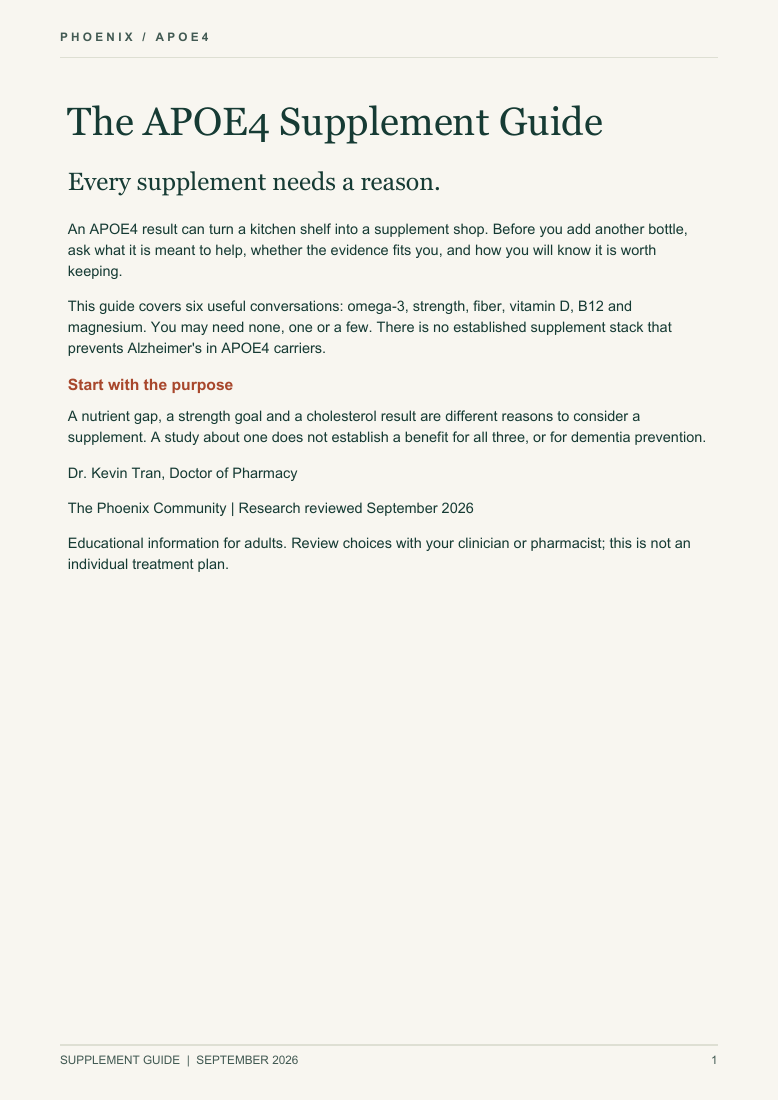 The APOE4 Supplement GuideCompare supplement evidence and questions to ask before buying.
Phoenix APOE4 ResearchClinical trial engineAPOE4 doctor directory