Free guide · For APOE4 carriers
Exercise is the closest thing you have to a drug that works on APOE4.
You have heard exercise is good for your brain. Here is the sharper number: a 2025 dose-response meta-analysis of 29 studies and more than 1.4 million people found high-intensity activity cut Alzheimer’s risk by 26%, and every extra 10 MET-hours a week (about two and a half hours of brisk walking) tracked with roughly another 15% drop. Not vague advice. A dose-response curve. This free guide walks through the three pillars of training that matter, the mechanisms connecting muscle to brain, what the evidence says about carriers specifically, and the weekly plan I actually run myself.
The PDF lands in your inbox in seconds. No spam, only the APOE4 research you’d actually want to hear about.
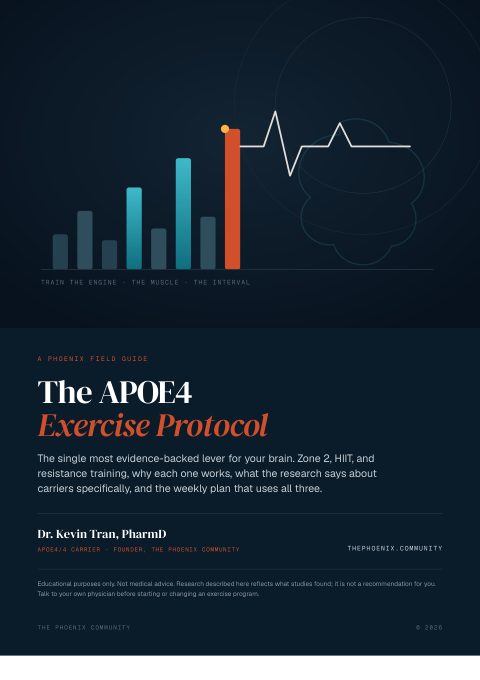
2x
the general-population effect
n=786, Fraser et al. 2022
17 pages · PubMed-cited
The honest answer on genotype
Does it help carriers more? It’s not settled, but it’s not a wash either.
Most exercise advice treats activity as generically good for everyone. The carrier-specific research is more interesting than that, and the honest version has real signal pointing both directions.
- A real, measured signal
Carriers’ brains responded twice as strongly
In a 12-year study of 786 middle-aged and older adults, each 10 MET-hours of weekly activity tracked with a larger hippocampal volume overall. Among older APOE4 carriers specifically, the effect per unit of activity was double the general effect.
- Read the caveat honestly
Not every study points the same way
The 2025 meta-analysis behind the 26% risk reduction also ran a subgroup analysis, and in that specific analysis the protective effect looked more pronounced in non-carriers. The FINGER trial and Nurses’ Health Study point toward a carrier benefit too, but one signal landed at p = 0.07, just outside significance.
The carrier brain responded to activity at twice the general rate.
What’s inside
Three pillars, sorted honestly by the strength of the evidence.
Every claim is PubMed-cited, sample sizes included, animal studies clearly labeled.
- 01
The three pillars
Why cardio alone, or lifting alone, leaves real protection on the table.
The framework - 02
Zone 2, your base layer
The pace and dose behind a randomized trial on cerebral blood flow.
The base - 03
HIIT, read honestly
What a 5-year randomized trial found, and did not find, for brain volume.
The honest limit - 04
Resistance training, the missing half
The SMART trial: 48% versus 27% back to normal cognition.
The RCT - 05
How muscle talks to your brain
BDNF, irisin, insulin, ApoB, and the glymphatic system, mapped by evidence tier.
Mechanism - 06
The genotype question, and your week
What the carrier-specific data shows, plus the template I run myself.
The plan
And what is oversold
HIIT as a brain hack, grip strength as noise. Read the caveat closely.
The guide gives HIIT, grip strength, and the “carriers benefit more” claim the same honest treatment as everything else: what the trials actually found, not what sounds motivating.
Consistency beats intensity, every time, over decades. A program you can still be running in five years beats a perfect month you cannot sustain.From the guide · the 90-day plan

Why I built this
“I am a Doctor of Pharmacy. I have read about a lot of drugs that promise a fraction of what a hard walk and a barbell can do. I train roughly six hours of Zone 2 and seven and a half hours of strength work a week now, and stacked with diet, my ApoB dropped from 115 to 70. That is one person’s result, not a promise about yours. This guide is what I wished someone had handed me instead of a vague ‘stay active’ pamphlet.”
Dr. Kevin Tran · Doctor of Pharmacy · APOE4/4 carrier · Founder
Read my storyYou don’t have to train alone
Turn the protocol into numbers you can actually see move.
Inside Phoenix, your training weeks sit next to your bloodwork against APOE4-aware targets, alongside a pod of carriers with similar monthly goals.
Your pod
A small group of APOE4 carriers with similar monthly goals, so your training does not have to stay solo.
Training that speaks APOE4
Tag Zone 2, HIIT, and strength sessions in your daily check-in, sync from Apple Health or Oura, and see how consistency lines up with your own numbers.
Bloodwork that speaks APOE4
Track 27 APOE4-aware biomarkers, including ApoB and fasting insulin, against carrier-specific targets, not generic “normal.”
A community that did the homework
Hundreds of carriers who have had the exact HIIT, grip-strength, and genotype conversations in this guide.
Common questions
Frequently asked questions.
Does exercise actually help more if you carry APOE4, or is that just marketing?
The honest answer is that it leans toward yes, but it is not settled. A 12-year study of 786 adults found that among older APOE4 carriers, hippocampal volume grew twice as much per unit of activity as it did in the general sample (Fraser et al., 2022). But a separate 2025 meta-analysis of 1.4 million people found the protective effect against Alzheimer’s risk looked more pronounced in non-carriers in its subgroup data. What is not in question either way: doing nothing is the worst option on the table.
Is HIIT the best workout for brain health, since it feels the most "advanced"?
Not automatically. A large 2026 randomized trial (Generation 100) followed adults for five years on HIIT, moderate-intensity training, or standard activity guidelines. Four years after the programs ended, the HIIT group showed greater hippocampal volume loss than the group that simply followed guidelines. HIIT still raises your fitness ceiling fast, it just is not a proven brain-structure hack on its own.
Does lifting weights actually do anything for cognition, separate from cardio?
Yes, and it has its own randomized-trial evidence. In the SMART trial, 100 people with mild cognitive impairment did six months of progressive resistance training. Afterward, 48% of the lifting group scored back in the normal cognitive range on a standard test, versus 27% of the group that did not lift (Fiatarone Singh et al., 2014).
Does my grip strength actually mean anything?
It is a real signal, with a real limit. A meta-analysis of 27,588 people found weaker grip strength was associated with 54% higher dementia risk (Cui et al., 2021). That is an association, not proof. A 2025 genetic study found grip strength does have a causal effect on cognition, but no causal link to dementia specifically (Sun et al., 2025). Grip predicts risk; it does not appear to independently cause the disease by that method.
How much exercise is actually the target each week?
The dose behind most of the evidence in the guide is 150 or more minutes of Zone 2 cardio, plus two to four resistance-training sessions, plus one or two shorter HIIT sessions if you want them. The guide includes a concrete weekly template and a four-week ramp for anyone starting from zero.
Get the free guide
Your genes set the starting line. What you do three or four times a week decides the rest.
Enter your email and we’ll send the APOE4 Exercise Protocol straight to your inbox, plus the research and member experiments we publish each week.
Straight to your inbox. No spam, only APOE4 research worth your time, and you can leave with one click.
This guide is educational and not medical advice. Several human studies cited are small, and some findings are drawn from animal or cell models, which are clearly labeled as such. The founder’s personal results are a single individual’s experience (n=1) and are not typical or guaranteed. Always consult your own physician before starting or changing an exercise program, especially if you have a heart condition, joint issue, or other existing condition.
Daily protocol
More free guides.
 The APOE4 Sleep & Glymphatic ProtocolExplore sleep research and what it does not yet establish.
 The APOE4 Diet PlaybookCompare dietary approaches and plan what goes on your plate.
 The APOE4 Inflammation, Gut & Stress GuideExplore the research and questions about what to measure.
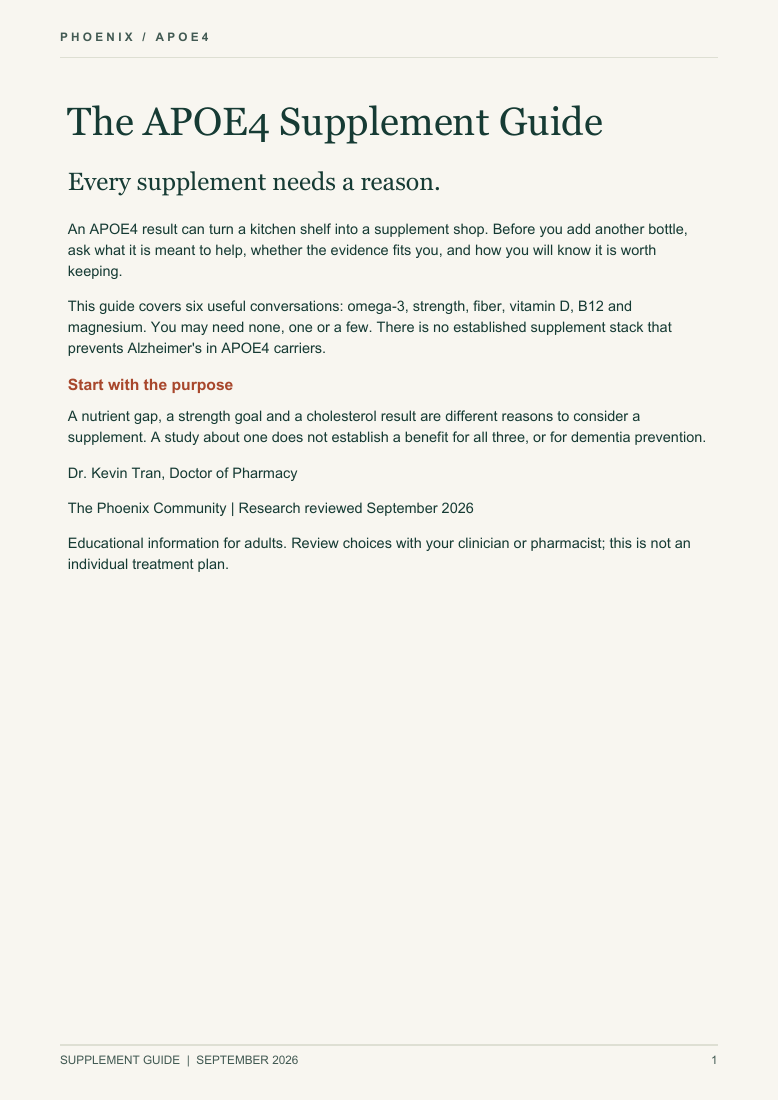 The APOE4 Supplement GuideCompare supplement evidence and questions to ask before buying.
Phoenix APOE4 ResearchClinical trial engineAPOE4 doctor directory