Free guide · For APOE4 carriers
Sauna, cold, and light are not equally proven.
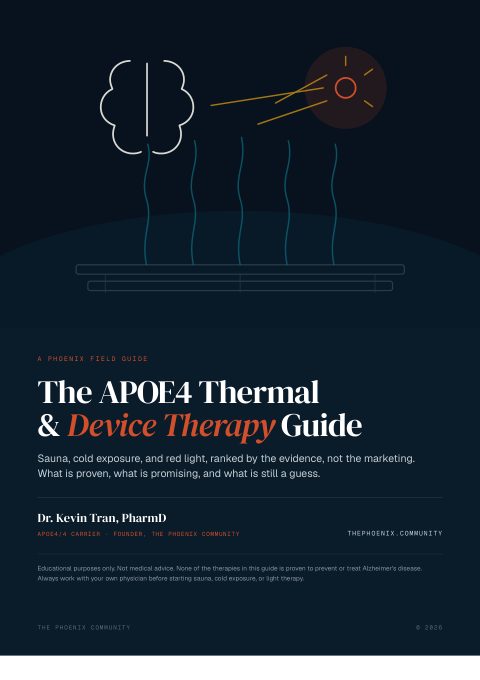
Your feed is full of sauna influencers, cold plunge tubs, and red light helmets, and every seller swears theirs is the one protecting your brain. Here is the sharper finding: a 20-year Finnish cohort of 2,315 men found frequent sauna users had a 66% lower risk of dementia. Cold exposure spikes real hormones in your body, but no study has ever tested it against dementia risk. Red light devices show real gains in small trials, and at least one well-designed trial found nothing. This free guide ranks all three honestly, by the actual evidence, not the marketing.
The PDF lands in your inbox in seconds. No spam, only the APOE4 research you’d actually want to hear about.
66%
lower dementia risk
n=2,315, KIHD cohort
18 pages · PubMed-cited
The finding almost nobody frames honestly
It is not “all three protect your brain.” It is sharper than that.
Most wellness marketing treats sauna, cold, and light as interchangeable brain hacks. They are not the same kind of evidence, and the honest ranking is more useful than the exciting pitch.
- One human cohort, 20 years
Sauna has the strongest evidence here
In 2,315 middle-aged Finnish men followed for a median of 20.7 years, frequent sauna use tracked with a 66% lower risk of dementia and a 65% lower risk of Alzheimer’s, even after adjusting for the obvious confounders. It is an observational cohort, not a randomized trial.
- Mechanism vs proof
Cold exposure’s brain claim is borrowed
Cold water reliably spikes norepinephrine by 530%, real and measurable. But the “cold shock proteins protect your brain” claim comes from sedated patients cooled for cardiac arrest, not from anyone stepping into a plunge tub. No dementia trial for cold exposure exists.
More frequent sauna use tracked with sharply lower dementia risk.
What’s inside
Sorted honestly, by the strength of the evidence.
Every claim is PubMed-cited, sample sizes included, animal and cell studies clearly labeled.
- 01
The evidence-tier ladder
Why sauna, cold, and light cannot carry the same weight of proof, ranked before you spend a dollar.
The spine - 02
Sauna’s 20-year human cohort
What 2,315 Finnish men, tracked two decades, actually found about dementia risk.
Tier 1 - 03
The exact sauna dose and safety rules
Frequency, duration, temperature, and who should talk to a doctor first.
Protocol - 04
Cold exposure’s real gap
The hormone spike is real. The brain-protection claim is borrowed from a different field.
Tier 2 - 05
Red light’s mixed trial record
Four small positive trials, one negative one, and what “clinically proven” ads leave out.
Tier 3 - 06
Stacking it into one week
A sample weekly template, plus the myths worth dropping before you spend on any device.
The template
And what is oversold
Cold plunge brain claims, and “clinically proven” red light ads. Read the label closely.
The guide holds cold exposure’s brain-protection claims and red light’s marketing promises to the same honest standard as everything else: what the trials actually found, not what sounds exciting.
One is backed by a 20-year human study. One is mostly borrowed physiology. One is early, small, and genuinely mixed. You deserve to know which is which before you spend money or time on any of them.From the guide · ranking sauna, cold, and light by the evidence

Why I built this
“When I started looking into sauna, cold plunges, and red light helmets for my own protocol, I wanted a straight answer, not another sales page promising all three protect your brain equally. They do not. One has twenty years of human data behind it. The other two are still early. I built sauna into my own routine because the evidence earned it, not because it was trending. This guide gives you the same honest ranking I built for myself.”
Dr. Kevin Tran · Doctor of Pharmacy · APOE4/4 carrier · Founder
Read my storyYou don’t have to guess alone
Turn what you try into a number you can actually see.
Inside Phoenix, sauna sessions, cold exposure, and any device you try become one more habit tracked against APOE4-aware context, alongside a pod of carriers with similar monthly goals.
Your pod
Matched to fellow APOE4 carriers, so you are not the only person weighing sauna schedules and cold plunge safety alone.
Track what you actually try
Log sauna sessions, cold exposure, or a red light device, and see whether any of it is moving your own numbers instead of guessing.
Bloodwork that speaks APOE4
Track 27 APOE4-aware biomarkers against carrier-specific targets, not generic “normal.”
A community that did the homework
About a third of members are healthcare professionals, sorting the same sauna, cold, and light claims you are.
Common questions
Frequently asked questions.
Is sauna actually proven to lower dementia risk, or is that just correlation?
It is the strongest human evidence in the guide, but it is still an observational cohort, not a randomized trial. In 2,315 middle-aged Finnish men tracked for a median of 20.7 years, those who used a sauna 4 to 7 times a week had a 66% lower risk of dementia and a 65% lower risk of Alzheimer’s than once-a-week users, even after adjusting for age, blood pressure, smoking, and other known risk factors. The confidence interval is wide (16% to 71% for dementia), and it comes from one Finnish research group and one cohort of men, so it shows a strong association, not proof that sauna alone caused the difference.
Do cold plunges protect your brain the way sauna does?
No sauna-style human dementia study exists for cold exposure, none has ever been run. What is real is the physiology: a 1-hour cold water immersion study found plasma noradrenaline rose 530% and dopamine rose 250%. The claim that cold plunges activate the same "cold shock proteins" as medical hypothermia is a stretch, that research comes from sedated patients cooled for cardiac arrest, not people briefly stepping into a tub.
Are red light or photobiomodulation devices clinically proven for Alzheimer’s?
No device is FDA-approved or FDA-cleared to treat, prevent, or diagnose Alzheimer’s or any dementia. The trial record is genuinely mixed: an 80-person placebo-controlled trial found a 3.87-point cognitive improvement over 12 weeks, three smaller trials also found gains, and a separate 30-person double-blinded trial found no significant difference from a sham device at all. Four small positive trials and one negative trial is early and promising, not proof.
What is the actual sauna dose that showed a benefit?
The strongest signal came from 4 to 7 sessions per week, in traditional Finnish dry heat around 80 to 100°C, with sessions longer than 19 minutes tied to a lower risk of sudden cardiac death than sessions under 11 minutes. That is a real time commitment. The 2 to 3 times a week group still trended favorably, just without reaching statistical significance on its own, so something consistent beats nothing perfect.
Is it safe to combine sauna or cold plunging with a heart condition?
Not without your physician’s clearance first. Sauna combined with alcohol is behind a disproportionate share of sauna-related cardiac events, and anyone with a recent heart attack, unstable angina, or severe aortic stenosis is advised to avoid sauna until cleared. Cold exposure causes a sudden, fast spike in heart rate and blood pressure the moment cold water hits your skin, a real risk for anyone with uncontrolled hypertension, coronary artery disease, or a history of cardiac events.
Get the free guide
Rank the evidence. Then pick what fits your life.
Enter your email and we’ll send the APOE4 Thermal & Device Therapy Guide straight to your inbox, plus the research and member experiments we publish each week.
Straight to your inbox. No spam, only APOE4 research worth your time, and you can leave with one click.
This guide is educational and not medical advice. None of these therapies is proven to prevent or treat Alzheimer’s disease, and several findings come from small trials or from animal and cell models rather than confirmed human outcomes. Sauna and cold exposure both place real, fast stress on your cardiovascular system. Always work with your own physician before starting sauna, cold exposure, or light therapy, especially if you have a heart condition, are pregnant, or take blood pressure medication.
Daily protocol
More free guides.
 The APOE4 Sleep & Glymphatic ProtocolExplore sleep research and what it does not yet establish.
 The APOE4 Diet PlaybookCompare dietary approaches and plan what goes on your plate.
 The APOE4 Exercise ProtocolExplore aerobic exercise, higher-intensity sessions and strength training.
 The APOE4 Inflammation, Gut & Stress GuideExplore the research and questions about what to measure.
Phoenix APOE4 ResearchClinical trial engineAPOE4 doctor directory