Free guide · For APOE4 carriers
Your plate changes what the gene does to your cholesterol.
You have read ten different “brain diets,” and half of them contradict the other half. Here is the sharper finding: across three controlled UK feeding trials, E4 carriers did not just start with higher cholesterol and ApoB, they dropped more than E3/E3 carriers when the same diet swap was made. Not that carriers are more broken. That carriers are more responsive to the fix. This free guide walks through why aggressive keto deserves real caution for many carriers, why the red meat headlines picked the wrong villain, and the one boring fiber move with results in the range of a low-dose statin, sorted honestly by how strong the evidence actually is.
The PDF lands in your inbox in seconds. No spam, only the APOE4 research you’d actually want to hear about.
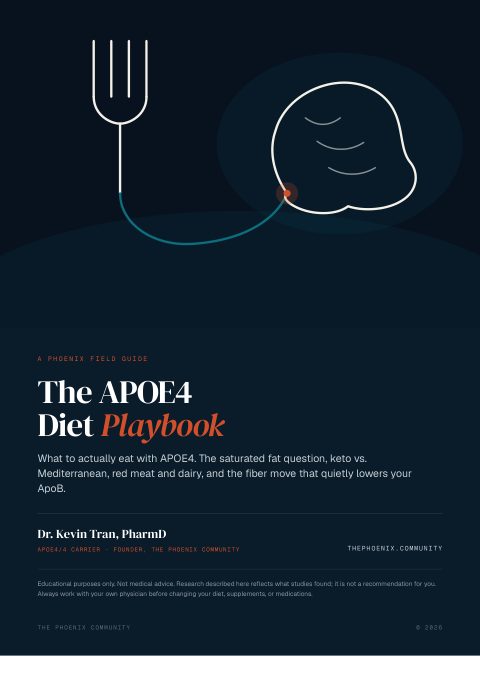
19%
lower dementia risk
n=133,771, Li et al. 2025
18 pages · PubMed-cited
The finding almost nobody frames honestly
It is not “fat is bad.” It is sharper than that.
Most diet advice treats saturated fat as generically bad for everyone. Three controlled UK feeding studies did something more specific, and the honest version of it is more useful than the scary one.
- Three feeding trials, read carefully
Same fat, a bigger response
Across three controlled UK trials, E4 carriers started every one with the highest baseline cholesterol, LDL, and ApoB, E3/E3 in the middle, E2 lowest. When researchers swapped saturated fat for something else, E4 carriers also dropped more than E3/E3 did on the identical trade.
- Inflammation, not just cholesterol
The reframe: responsive, not broken
On a high-saturated-fat diet, a blood marker of inflammation rose significantly in E3/E4 carriers. It did not rise in E3/E3 participants eating the identical diet. Same fork, same fat, different cost, depending on genotype.
One swap beat the meat itself.
What’s inside
Sorted honestly, by the strength of the evidence.
Every claim is PubMed-cited, sample sizes included, animal studies clearly labeled.
- 01
The gene that changes your plate
Why “eat real food” gets most people 90% there, and why the last 10% is different when you carry the gene.
The spine - 02
Mediterranean vs. keto, the honest answer
Why aggressive keto is a riskier bet for many carriers, and the one blood test that turns a guess into a number.
The caution - 03
Red meat and dairy: it’s the processing
What the newest genotype-specific data actually found, and why the headlines picked the wrong villain.
The data - 04
The fiber lever that moves your ApoB
A boring, cheap move with results in the range of a low-dose statin, from food alone.
The lever - 05
Ultra-processed food, by the numbers
Each extra daily serving carries a measurable cost, and where the evidence is honestly not unanimous.
The evidence - 06
Build your plate, the 90-day plan
A simple framework for most days, plus when to re-test your ApoB and what to do with the result.
The plan
And what is oversold
Keto as “the ultimate brain diet.” Read the caution closely.
The guide gives keto’s brain-health claims, the “my cholesterol looks fine” myth, and the all-fat-is-bad myth the same honest treatment as everything else: what the trials actually found, not what sounds reassuring.
You are not more broken. You are more responsive. The same swap that moves the needle a little for most people can move it a lot for you.From the guide · the reframe that changes everything else

Why I built this
“I have read the same conflicting diet takes you have. Keto forums swearing by more fat, cardiologists warning about that same fat. I am a Doctor of Pharmacy, so I went looking for what the research actually says about my own genotype, not the internet’s most confident answer. What I found is that my genes do not make me broken, they make me more responsive, to the food that hurts and the food that helps. I test my own ApoB, I eat mostly fish and unprocessed protein, and I do not pretend a stricter diet than the evidence supports. This is the guide I wish someone had handed me first.”
Dr. Kevin Tran · Doctor of Pharmacy · APOE4/4 carrier · Founder
Read my storyYou don’t have to track it alone
Turn the playbook into a plate you can see.
Inside Phoenix, your food swaps are one more number you track against APOE4-aware context, alongside a pod of carriers doing the same thing.
Bloodwork that speaks APOE4
Upload your labs and see your ApoB, hs-CRP, and full panel against APOE4-aware targets, not generic “normal,” with trends over time.
Build the full evidence trail
Record food swaps, timing, adherence, and every overlapping intervention beside ApoB and inflammation movement.
Your pod
A small group of fellow carriers, matched to you, so a decision as personal as keto versus Mediterranean does not happen alone.
A community that did the homework
About a third of members are healthcare professionals, and many have made the exact same keto-versus-Mediterranean decision you are facing.
Common questions
Frequently asked questions.
Does the APOE4 gene really change how my body responds to fat, or is that oversimplified?
It is specific, not oversimplified. Across three controlled UK feeding studies, E4 carriers started with the highest baseline cholesterol, LDL, and ApoB (E3/E3 in the middle, E2 lowest), and when researchers swapped saturated fat for something else, E4 carriers saw a significantly larger drop in cholesterol and ApoB than E3/E3 got from the identical swap [Griffin et al., 2018]. A separate study found a blood marker of inflammation rose in E3/E4 carriers on a high-saturated-fat diet but not in E3/E3 participants eating the same food [Carvalho-Wells et al., 2012].
Is keto actually risky for APOE4 carriers?
There is no dedicated trial that has put APOE4 carriers on keto versus Mediterranean head-to-head and measured brain outcomes, so this is a reasoned caution, not a settled verdict. Short-term trials show ketogenic diets often raise LDL by 18 to 70 mg/dL in normal-weight adults, and carriers already run a larger LDL and ApoB response to saturated fat on the same food. A 2024 study of 80 long-term keto dieters with markedly elevated LDL found no significant difference in coronary plaque burden versus controls, which complicates the simple story. The guide’s honest stance: if you are drawn to keto, test your ApoB before and after.
Does red meat cause dementia in APOE4 carriers?
The best genotype-specific data found it was the ratio of processed to total meat that predicted higher dementia risk, and this held regardless of genotype. Unprocessed meat was neutral to favorable for APOE4 carriers specifically [Norgren et al., 2026]. A larger US study found swapping one daily serving of processed red meat for nuts or legumes was linked to 19% lower dementia risk [Li et al., 2025].
What is the single cheapest, most actionable move in the guide?
Soluble fiber. Across 29 randomized controlled trials, daily psyllium lowered LDL cholesterol by about 14 mg/dL, and the fiber-rich Portfolio diet pattern lowered LDL by about 17% in pooled trials, in the range of a low-dose statin, from food alone [Zhu et al., 2024; Chiavaroli et al., 2018].
Is all packaged food bad for my brain?
No. The NOVA classification system has four groups, and only the fourth (industrial formulations built with sweeteners, emulsifiers, and additives for shelf life) is the concern. Canned fish, frozen vegetables, and plain yogurt are Groups 1 and 3, not the target. Ultra-processed food still makes up nearly 58% of daily calories in the US, the largest share of any high-income country, which is why cutting Group 4 specifically is high-leverage [Hall et al., 2019; Weinstein et al., 2025].
Get the free guide
Food is a lever. Pull the ones that are proven.
Enter your email and we’ll send the APOE4 Diet Playbook straight to your inbox, plus the research and member experiments we publish each week.
Straight to your inbox. No spam, only APOE4 research worth your time, and you can leave with one click.
This guide is educational and not medical advice. It describes what population studies have found and, in places, what Kevin does personally, which is a single person’s experience and not a recommendation for you. Individual dietary needs vary with other health conditions, medications, and lab results. Several findings cited are observational, or come from small or animal studies, clearly labeled as such. Always work with your own physician or a registered dietitian before making major changes to your diet, especially before starting a ketogenic or other restrictive eating pattern.
Daily protocol
More free guides.
 The APOE4 Sleep & Glymphatic ProtocolExplore sleep research and what it does not yet establish.
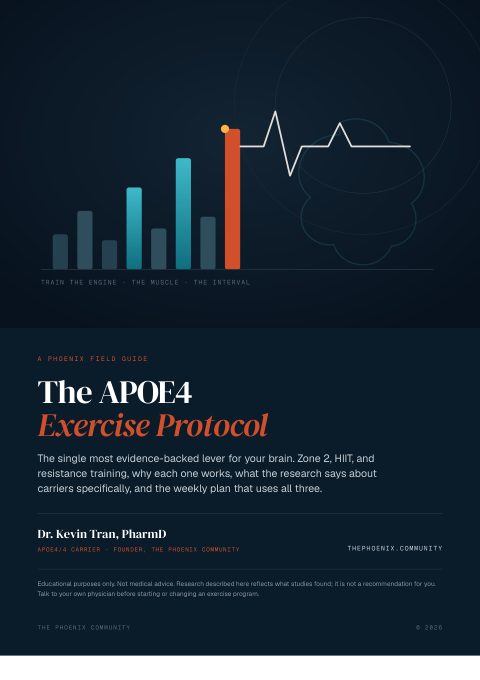 The APOE4 Exercise ProtocolExplore aerobic exercise, higher-intensity sessions and strength training.
 The APOE4 Inflammation, Gut & Stress GuideExplore the research and questions about what to measure.
 The APOE4 Supplement GuideCompare supplement evidence and questions to ask before buying.
Phoenix APOE4 ResearchClinical trial engineAPOE4 doctor directory