Free guide · For APOE4 carriers
Every supplement needs a reason.
An APOE4 result can turn a kitchen shelf into a supplement shop. Before you add another bottle, ask what it is meant to help, whether the evidence fits you, and how you will know it is worth keeping. This guide covers useful options, real limits, and the questions to take to your clinician.
The PDF lands in your inbox in seconds. No spam, only the APOE4 research you’d actually want to hear about.
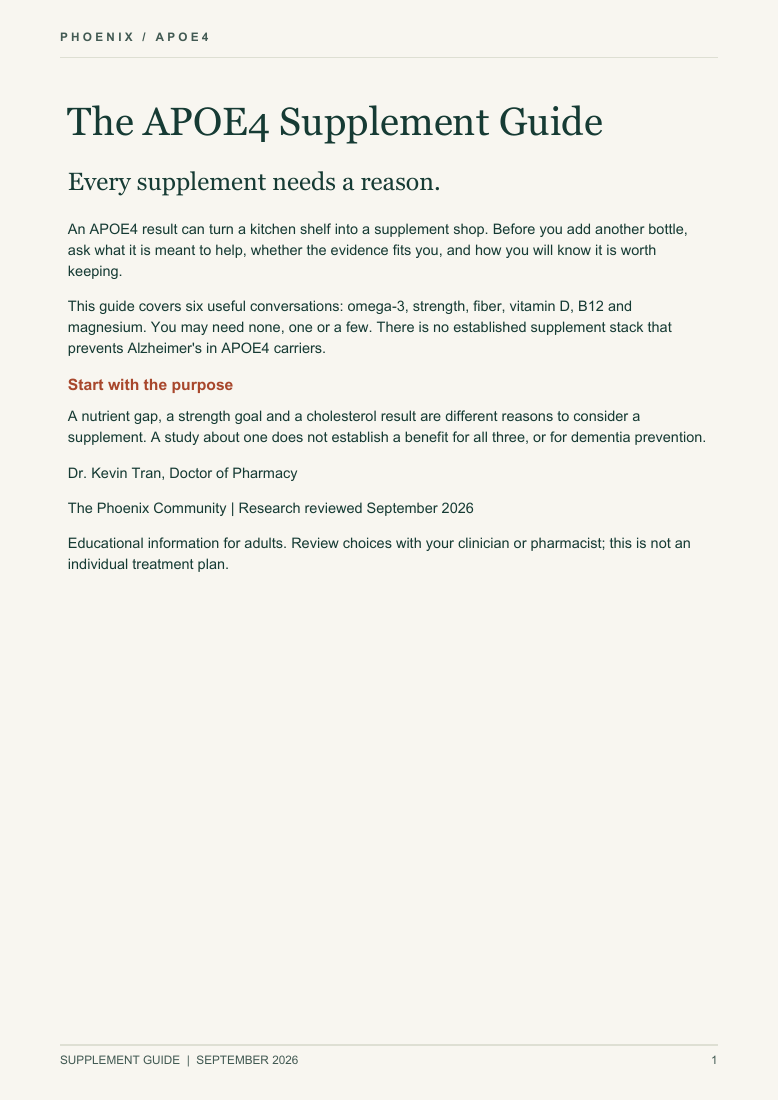
8 pages · Research and practical checks
Start with the purpose
A useful supplement solves a specific problem.
Your genotype is context. Food intake, symptoms, medicines and an appropriate clinical assessment help determine whether a supplement belongs in your plan.
- Match the evidence to the goal
Strength, nutrient gaps and lipids are different goals
Creatine alongside resistance exercise can support strength. Psyllium can help lower LDL cholesterol. Replacing a deficient nutrient can be appropriate. None of those findings proves that a supplement prevents Alzheimer’s in APOE4 carriers.
- Keep the claim in proportion
A mechanism is a reason to study something
DHA delivery research is interesting, but a change in cerebrospinal fluid or an early pilot result cannot tell us that a commercial fish oil or LPC-DHA product prevents dementia. There is no established APOE4 prevention stack or supplement dose.
Better labels for better decisions.
Psyllium: a meta-analysis of 28 trials found lower LDL cholesterol and ApoB. It studied lipid outcomes, not dementia prevention. Read the analysis.
Omega-3 and vitamin D: a VITAL analysis found no significant APOE4 difference in their effects on cognitive change over two years. Read the study.
Inside the guide
Seven conversations. No compulsory stack.
Each option starts with a reason to consider it, the limits of the research, and a practical safety check.
- 01
Omega-3: fish or algae
Consider dietary intake and compare the actual EPA and DHA on the label. Brain-delivery research does not establish a prevention dose.
Dietary need - 02
Creatine with resistance exercise
The clearer practical case is strength and lean mass alongside training. Cognitive studies do not establish APOE4 prevention.
Strength - 03
Fiber: food first, psyllium if useful
A possible addition for a fiber or lipid goal. Use adequate water and check medicine timing.
Fiber & lipids - 04
Vitamin D: match the need
Consider total intake and a clinical indication. Avoid an automatic high blood target or routine testing based on genotype alone.
Nutrient gaps - 05
B12: investigate, then replace
Diet, absorption and medicines can matter. Elevated homocysteine needs a cause review, not an automatic high-dose B-complex.
Nutrient gaps - 06
Magnesium: review the need
Consider intake and kidney function. Sleep evidence is inconsistent, and more expensive forms do not establish better brain outcomes.
Conditional - 07
Low-dose lithium: ask your clinician first
Lithium orotate at a few milligrams a day is far below psychiatric doses. Population studies link more lithium in drinking water to less dementia, and a 2025 Nature study found brain lithium falls early in Alzheimer’s. Human prevention trials are still missing. Check kidney and thyroid function, and medicines that raise lithium levels, such as some diuretics, ACE inhibitors and anti-inflammatories.
Emerging
What does not make the launch list
A premium price is not a clinical result.
LPC-DHA, taurine, methylene blue and high-dose antioxidant regimens are not part of these selections. The evidence does not establish a general APOE4 prevention benefit that justifies recommending them here. A basic multivitamin can be a separate dietary-gap discussion; COSMOS results do not validate every premium formula.
For Phoenix members
Bring the evidence into your routine.
Phoenix recommended lists group the options by purpose, with exact label servings, research links and cautions.
Explore Phoenix recommended lists in the app, then use your supplement tracker to record what you actually take. Label servings help you compare products; they are not a personal prescription. Choose from our lists or pick your own products, and review with your clinician when needed. Members can shop the Phoenix private supplement store at prices negotiated for the whole Phoenix group: up to 35% off retail on most major brands in the US, and up to 25% in Canada. We are working hard to bring it to the UK and Australia next. Phoenix earns nothing on your purchases, so our recommendations stay unbiased.

Why I built this
After my diagnosis I did what every carrier does. I went online, and within a week I owned fifteen bottles, most of them recommended by a podcast, none of them checked against my own labs. I am a Doctor of Pharmacy. I know what a real trial looks like versus a label with a nice font. This guide is the version I wish I had before I spent that money: what the evidence actually supports, what to skip, and how to tell the difference.
Dr. Kevin Tran · Founder, The Phoenix Community
Read my storyYou do not have to keep it all in your head
Know what you take. Keep asking why.
Keep a clear list
Record your supplements and medicines so you have a useful starting point for a clinician or pharmacist review.
Put results in context
Keep bloodwork alongside your routine. Decide with your clinician which tests and follow-up are appropriate for you.
Learn together
Discuss the research with members who understand an APOE4 result. Someone else’s experience can prompt a question; it cannot establish what will work for you.
Common questions
Frequently asked questions.
Is there a supplement stack everyone with APOE4 should take?
No universal APOE4 supplement stack has been established to prevent dementia. A useful choice starts with a specific dietary gap or health goal, the evidence for that goal, and a review of your medicines and health conditions. Food, exercise, sleep and appropriate medical care remain the foundation.
Should APOE4 carriers take more fish oil?
Genotype alone does not establish a dose. DHA transport and biomarker studies cannot tell us that increasing a commercial fish oil dose prevents dementia. Consider food intake and the actual EPA and DHA content, and discuss high doses with your clinician, particularly if you have atrial fibrillation or take medicines that affect bleeding.
Do I need a high vitamin D blood level?
No automatic high target follows from an APOE4 result. Vitamin D can be appropriate for nutrient and bone-health needs, but excess can cause harm and trials have not established cognitive prevention benefits. Routine screening of all otherwise healthy adults is not recommended by the guidance summarized by NIH. Your clinician can decide whether testing or treatment is indicated.
Should I take B vitamins if homocysteine is normal?
B12 deficiency can still need treatment when homocysteine is normal. Diet, absorption, symptoms and medicines help determine the assessment. Conversely, elevated homocysteine is not a reason to automatically take a high-dose B-complex. Investigate the cause, and watch for overlapping B6 because chronic excess can cause nerve injury.
Are creatine and magnesium proven brain supplements?
Neither has established APOE4 dementia-prevention efficacy. Creatine has a clearer practical role alongside resistance exercise for strength. Magnesium may be relevant to an intake gap, but sleep trials are inconsistent and do not support a routine insomnia recommendation. Form and dose need to fit the person, especially when kidney function or medicines are relevant.
How do you choose products and brands?
We compare the exact ingredient, amount per serving, formulation, allergens and product-specific quality verification where available. A brand reputation or a quality seal on another product is not proof for the product in front of you. Certification concerns specified quality attributes; it does not prove a supplement prevents Alzheimer’s.
Get the free guide
Start with the question. Then consider the bottle.
Enter your email and we’ll send the APOE4 Supplement Guide to your inbox, plus the research and member experiments we publish each week.
Straight to your inbox. No spam, only APOE4 research worth your time, and you can leave with one click.
This guide is educational and not medical advice. Review supplements with your clinician or pharmacist before starting or changing them, especially if you take medicines, have kidney disease, are pregnant or are planning surgery. Research reviewed September 2026. None of these selections is presented as proven to prevent Alzheimer’s in APOE4 carriers.
Daily protocol
More free guides.
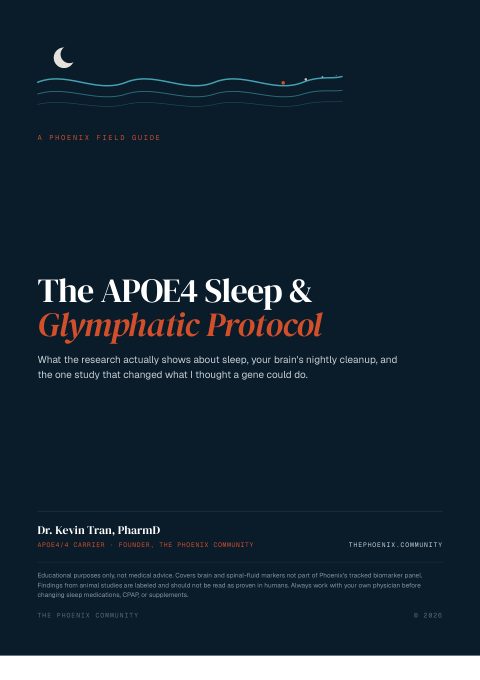 The APOE4 Sleep & Glymphatic ProtocolExplore sleep research and what it does not yet establish.
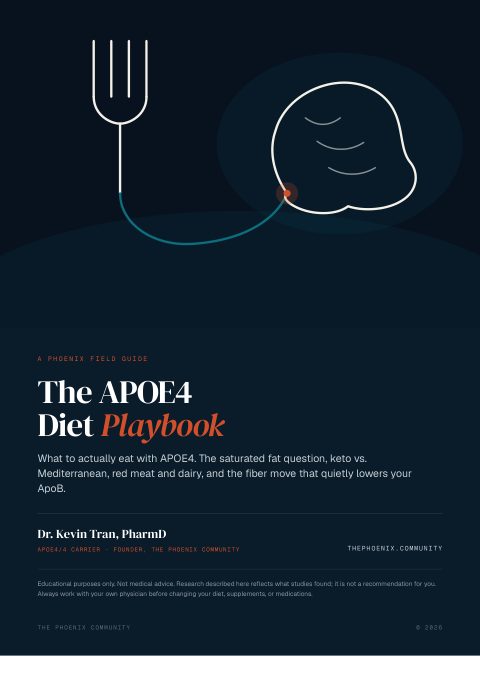 The APOE4 Diet PlaybookCompare dietary approaches and plan what goes on your plate.
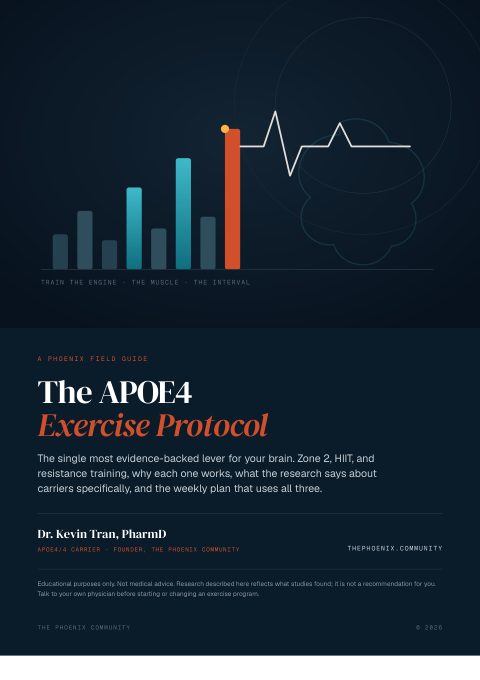 The APOE4 Exercise ProtocolExplore aerobic exercise, higher-intensity sessions and strength training.
 The APOE4 Inflammation, Gut & Stress GuideExplore the research and questions about what to measure.
Phoenix APOE4 ResearchClinical trial engineAPOE4 doctor directory