Phoenix APOE4 research.
APOE4 carriers are too often forgotten by mainstream healthcare and research. It’s time to take matters into our own hands and generate the data we need to beat the odds.
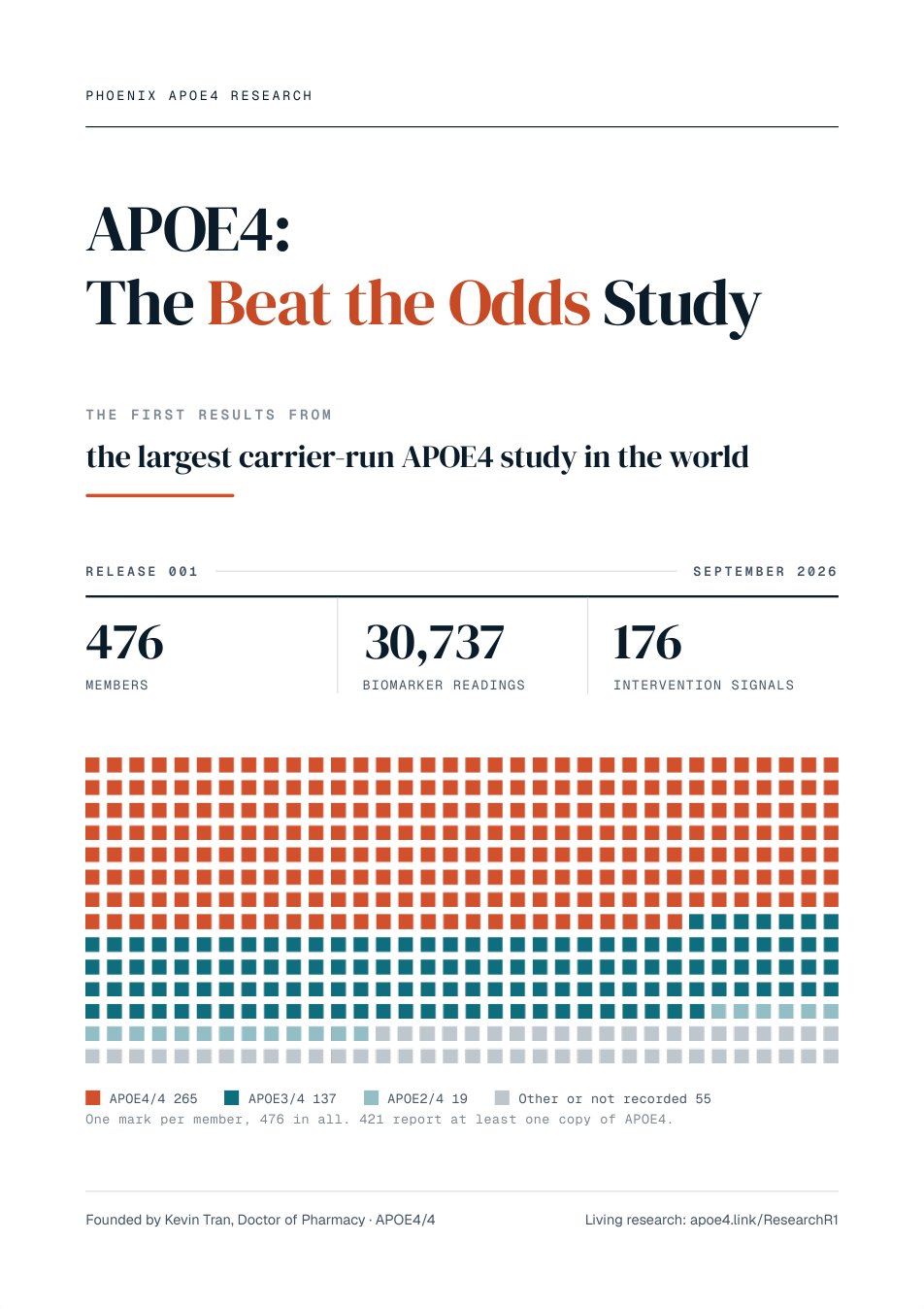
Release 001
APOE4: the Beat the Odds Study
Release 001 is a 43-page report on member experiments and measured results.
Read what members tried, what changed and the other interventions recorded at the time.
- 476members
- 30,737biomarker readings
- 176intervention signals
Get Release 001
What Release 001 found
What carriers tried, and what moved.
57 of 100 members who tested their blood twice lowered their LDL, and 56 of 100 lowered their triglycerides. These are the results that stood out, each with what else the member was taking.
Observational research: each member is compared with their own earlier self, with no placebo group. How to read these results
Medications
| Result | Member and time |
|---|---|
| Ezetimibe and psyllium lowered LDL 70% | 263 → 78 mg/dL in 70 days. APOE4/4 woman, 55, also on an estradiol patch and Lysoveta (DHA-LPC). |
| Metformin and tirzepatide lowered insulin 48% | 12.6 → 6.5 µIU/mL in 162 days. APOE3/4 woman, 67. Nothing else was recorded in her stack. |
Supplements
| Result | Member and time |
|---|---|
| Omega-3 lowered triglycerides 60% | 154 → 61 mg/dL in 102 days. APOE4/4 man, 58. His statin started near the follow-up test, too late to explain a change already under way. |
| Vitamin B12 lowered homocysteine 29% | 10.5 → 7.5 µmol/L in 139 days. APOE4/4 man, 53, also taking magnesium threonate, folate and a B complex. |
| Vitamin D3 raised vitamin D in 3 of 3 members who tested it | 28 → 102, 32 → 66 and 33 → 54 ng/mL. |
Sleep and habits
| Result | Member and time |
|---|---|
| Going to bed earlier added about 30 minutes of sleep | 56 of 68 members slept longer on their earlier-bedtime nights, and 59 of 66 under a stricter comparison. |
| Morning caffeine cut deep and REM sleep | By 111 and 82 minutes in two members, and about 8 minutes on average across 24 members who timed their caffeine. |
Six patterns repeated across members. The largest: magnesium glycinate with lower glucose in 12 members, and omega-3 in 8.
How to read these results.
Is this different from the research you already read?
Not in design. Most nutrition, supplement and lifestyle research that reaches the public is observational too, with no placebo group. The difference is that Phoenix names every limit and shows what else changed beside each result.
Can Phoenix tell which intervention made the difference?
Each case names the intervention most likely to have contributed, with the reason, and shows the member’s full recorded stack beside it. When several changes overlap, the result belongs to the whole stack, and Phoenix says so. The pooled analysis that will separate overlapping interventions across members is being built.
Does Phoenix check medication interactions?
Phoenix does not diagnose, treat, cure or prevent any disease, and does not check interactions with anything you already take. Discuss medication decisions with your clinician.
- Each member is compared with their own earlier self. Members chose their own interventions, so there is no random assignment and no placebo group.
- Every case shows everything else the member was taking at the time.
- In Release 001, no single supplement has shown community-level efficacy yet. That is a question of numbers: even a statin, a drug we know works, needs about 23 members per group to stand out from normal variation between people. Every member who tests twice brings those answers closer.
Studies with our partners.
Build your own record. Learn from others.
Choose a personal priority, record what you try and follow your results. Learn from current member research while you build your own record.