 The Phoenix Community
Get your memory baseline. Then find out what’s actually working.
I carry APOE4/4, and the question I hear most from carriers is an honest one: is any of this actually working? So I partnered with PREMAZ and the University of Cambridge to give carriers a real answer. Take a 10 to 15 minute precision memory test, free as part of our joint study, get your baseline today, and re-test in about three months to see if it moved.
 PREMAZ precision memory test
Built on a decade of Cambridge research
10 to 15 minutes, on a laptop or tablet · Normally a paid test, free for study participants.
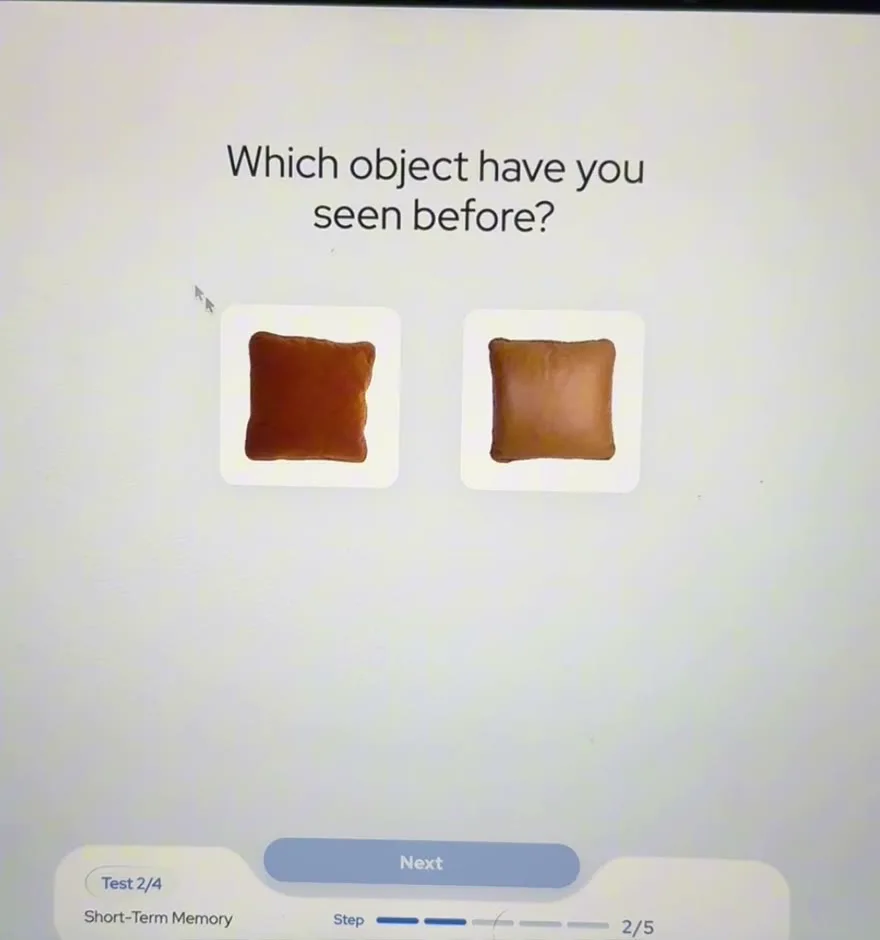
Actual PREMAZ test screen · not a mockup or illustration
Look closely. These two are almost the same.
That is not a design accident. It is the whole idea behind precision memory. Most cognitive tests ask a blunt question: did you remember this object, yes or no? PREMAZ asks a sharper one: exactly how well did you remember it, down to the shade and the shape.
Telling these two cushions apart, or knowing honestly that you cannot, is precision memory in action. That same measurement is what let PREMAZ catch differences in published Cambridge research even when a standard neurologist assessment came back normal.
Standard cognitive tests miss what PREMAZ catches.
Most memory tests give you a single blunt signal. PREMAZ measures something closer to the truth: how precise your memory actually is.
Did you remember, yes or no
Most memory tests score you on whether you remembered something at all. That is a blunt instrument, and it can look completely normal right up until a real change is already underway.
How precise was that memory
PREMAZ measures how precise and detailed your memory is on a continuous scale, not just whether you remembered. In published Cambridge research, that measurement caught differences even when standard neurologist assessments came back normal.
A decade of work behind ten minutes of testing.
PREMAZ is not new. It is built on more than ten years of research at the University of Cambridge, already validated in published studies and used in clinics and research settings across the UK and US.
Hear it from Dr. Julia Cooney.
Dr. Julia Cooney is a medical doctor, dementia researcher, and the founder of PREMAZ. In one minute, she explains why measuring how precise your memory is, not just whether you remembered, catches changes that standard cognitive tests miss.
Dr. Julia Cooney · Medical doctor, dementia researcher, and founder of PREMAZ
Four steps. Ten to fifteen minutes.
The test itself is simple. What happens with your results afterward is where PREMAZ actually does its work.
Test
Take it in 10 to 15 minutes on a laptop, tablet, or phone. No supervision needed.
Analyse
Precision-based algorithms score how faithfully you remembered, not just whether you did.
Track
Your results come back to you in a secure dashboard, and you download your own report.
Re-test
About three months later, so the change between your two scores becomes the answer.
A standard test and PREMAZ, side by side.
| What you’re comparing | A standard cognitive test | PREMAZ |
|---|---|---|
| What it measures | Whether you remembered, yes or no | How precisely you remembered |
| What it can pick up | Changes only once they are already obvious | Differences even when a standard assessment looks normal |
| How long it takes | Varies, often longer in a clinical setting | 10 to 15 minutes |
| Where you take it | Typically in a clinic, with supervision | Independently, on a laptop, tablet, or phone |
A joint study between Phoenix, PREMAZ, and Cambridge.
I partnered with PREMAZ (Prema Cognition) and the University of Cambridge to run a study on early memory change in people who carry APOE4 or have a family history of dementia. The goal is 300+ participants, to help build one of the largest studies of its kind focused on APOE4 and early memory change.
Built on 10+ years of Cambridge research
PREMAZ is a digital precision memory test built on more than ten years of research at the University of Cambridge, already used in clinics and research settings across the UK and US.
The goal: 300+ participants
More than 300 APOE4 carriers and people with a family history of dementia, building one of the largest studies of its kind. It only happens if people take part.
Who can take part
Confirmed APOE4 carriers, or anyone with a family history of dementia. No Phoenix membership required.
What taking part involves
A baseline test now, 10 to 15 minutes, and a re-test about three months later. Taking part also helps the University of Cambridge advance their research.
One result shows you where you are. Two show you if you’re changing.
A single PREMAZ score is a starting point. It is the second one, taken about three months later, that turns into an answer: whether the sleep, exercise, diet, supplements, and stress work you are already doing is actually moving your cognition, or not.
Your starting point
Ten to fifteen minutes, whenever you are ready. This is the number everything else gets compared to.
Your answer
The same test again. The change between your two scores, not either score alone, is what tells you whether your interventions are working.
Subtle cognitive changes can begin years before symptoms are visible.
Phoenix turns a memory score into an answer.
The PREMAZ test itself works the same whether or not you are a Phoenix member. What changes is what the result means once you have it.
Start straight from your dashboard
Phoenix members can launch the PREMAZ test from inside the app. No separate signup, no extra step.
Your data gives the score context
Phoenix already holds your sleep and wearable data, your supplements and experiments, and your daily check-ins on energy, brain fog, mood, and sleep quality. That context shows what was active when your memory score changed and builds the record future pooled analysis will use.
Keep your own report
Phoenix does not automatically import your PREMAZ results yet, so download and keep your own PREMAZ report after each test.
Not a member yet?
You do not need to join Phoenix to take the PREMAZ test. If you want your memory score connected to everything else you are already tracking, join Phoenix and it will be waiting on your dashboard.

I wanted a real answer, not another guess.
“I carry APOE4/4, and for years the honest answer to ‘is any of this actually working’ was I don’t really know. Standard memory tests are too blunt to catch a small, real change. PREMAZ is built to catch exactly that, so I partnered with PREMAZ and the University of Cambridge to bring this test to carriers, free, as part of a real study. I want carriers to get a real answer sooner than I did.”
Frequently asked questions.
Is the PREMAZ test really free?
Yes. PREMAZ is normally a paid test, but every participant in this joint study between Phoenix, PREMAZ, and the University of Cambridge takes it for free.
Who is eligible to take part?
Confirmed APOE4 carriers, and people with a family history of dementia. You do not need to be a Phoenix member to take part, and taking part also helps the University of Cambridge advance their research.
How long does it take, and what is it like?
About 10 to 15 minutes. It works best on a laptop or tablet, in a quiet room where you will not be interrupted. You take it twice: a baseline now, and a re-test about three months later.
Does a low score mean I have dementia?
No. PREMAZ is a research and tracking tool, not a diagnosis. APOE4 itself is a risk factor, not a diagnosis, and the same is true of any single memory test result. Talk with your own doctor about what your results mean for you.
Do I need to be a Phoenix member to take the test?
No. The PREMAZ test is open to any eligible APOE4 carrier or person with a family history of dementia. Phoenix members get one extra thing: they can start the test straight from their Phoenix dashboard, where Phoenix already holds the sleep, supplement, and check-in data that helps a memory score mean something.
Get your baseline. Find out what’s working.
Enter your email and get instant access to your free PREMAZ memory test, plus the research and member experiments Phoenix publishes each week.
This page is educational and is not medical advice. PREMAZ is a research and tracking tool; it does not diagnose or predict Alzheimer’s disease for an individual. APOE4 is a risk factor, not a diagnosis. Always talk with your own physician about your results and your risk.