Free guide · For APOE4 carriers
Your problem was never a lack of data. It was signal versus noise.
You have a CGM in a drawer, a wearable on your wrist, and a spreadsheet that stopped getting updated months ago. Here is the honest problem: a single blood draw can land 10 to 15% away from your true number, purely from normal day-to-day biological variation that has nothing to do with your protocol [Sandberg et al., 2022]. More data was never going to fix that. A system for telling signal from noise does. This free guide is that system: the core panel worth drawing, what your CGM and wearable actually prove, how to run a self-experiment that produces a real useful evidence, and the evidence-ranked lever stack, sorted honestly by what the trials support.
The PDF lands in your inbox in seconds. No spam, only the APOE4 research you’d actually want to hear about.
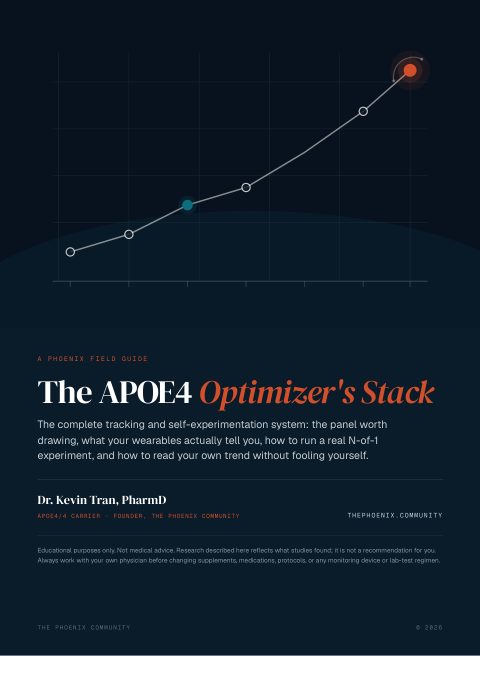
18 pages · PubMed-cited
The reframe most trackers miss
More data was never the answer. A method for reading it was.
Optimizers rarely have a discipline problem. They have a signal-to-noise problem, and almost nothing in the wearable and supplement industry is built to fix that.
- The real problem
It was never a lack of data
Every biomarker moves for reasons that have nothing to do with your intervention. A single blood draw can land 10 to 15% away from your true number, purely from normal day-to-day biological variation [Sandberg et al., 2022]. More tracking without a way to separate signal from noise just gives you more ways to be wrong with confidence.
- The fix
Every intervention, one measurement plan, explicit decision rules
An N-of-1 trial is a recognized, peer-reviewed research method: a study with a sample size of exactly one, you [Vohra et al., 2015]. Record every start, stop, dose, and adherence pattern, then re-test for long enough that the marker can respond. Stagger changes when practical to improve separation. Phoenix is building pooled analysis for the real-life periods when several interventions overlap.
Diet, exercise, and medication together, tracked as one trend.
What’s inside
Ranked honestly, by what the trials actually support.
Every claim is PubMed-cited, sample sizes included, animal and n=1 data clearly labeled as such.
- 01
The core panel worth drawing
The essential five markers, plus two worth adding, and the APOE4-aware target for each.
The panel - 02
What your CGM actually proves
The 2026 review that separates a real benefit from the marketing, and who it is actually for.
Signal check - 03
Sleep stages and HRV, decoded
How accurate your wearable’s estimate really is, and when to trust a single night’s reading.
Wearables - 04
The N-of-1 method
The five-step loop that turns a guess into a real answer, with a full worked example.
The method - 05
The lever stack, ranked by evidence
Every intervention sorted by what the trials support, anchored in the two-year FINGER trial, supplements included.
The stack - 06
The regression-to-the-mean trap
Why one good reading rarely proves your fix worked, and the rule for telling a real trend from noise.
Don’t fool yourself
And the myths worth dropping
More data, faster reactions, bigger stacks. Checked against the evidence.
The guide closes with seven optimizer myths, from “more data always means more insight” to “supplements are the fastest way to move a stubborn marker,” each checked against what the trials actually found.
One reading is a rumor. Three readings are a trend.From the guide · the regression-to-the-mean rule

Why I built this
“I researched everything, and I tracked everything, for two years, one blood PDF and one CGM export at a time. My ApoB eventually dropped from 115 to 70. But I got there slower than I needed to, because I kept reacting to single data points instead of trends, and changing three things at once so I never actually knew which one worked. This guide is the system I wish I had on day one. It will not make you track less. It will make every number you already track actually mean something.”
Dr. Kevin Tran · Doctor of Pharmacy · APOE4/4 carrier · Founder
Read my storyYou don’t have to run the system alone
Turn the stack into one trend you can actually trust.
Inside Phoenix, every marker in this guide lives in one place, tracked against APOE4-aware targets, alongside a peer group already running the same kind of stack.
Attribution Analysis
Compare any two blood tests side by side and see which tracked change likely explains the movement, the closest thing to an automated N-of-1 readout.
One tracking hub, not six exports
Bloodwork, wearables, supplements, and daily tags all live in one trend line instead of a spreadsheet that stops getting updated.
27 APOE4-optimized biomarkers
Track your panel against carrier-specific targets, not generic “normal,” with your full trend line across every test.
Experiments (XP-Packs)
Pre-built N-of-1 protocols with evidence grades and time commitments, run and shared with a peer group who has done the homework.
Common questions
Frequently asked questions.
Does more tracking actually help, or is that the myth this guide pushes back on?
It is the myth. More biomarkers and more wearable data without a decision rule just gives you more noise to misread. A single blood draw can land 10 to 15% away from your true number, purely from normal day-to-day biological variation [Sandberg et al., 2022]. The guide argues the fix is a method for reading your data, not more of it.
Is a CGM worth wearing if my labs already look normal?
The evidence is more nuanced than the marketing. A 2026 systematic review pooling 23 studies and over 1,000 non-diabetic participants found CGM use meaningfully improved glucose control in people with prediabetes, but showed no appreciable benefit in people who were already fully healthy and normoglycemic [Liao et al., 2026]. The guide is honest that the biggest wins go to carriers whose numbers are drifting, not carriers who are already dialed in.
How accurate is a ring or wearable at tracking sleep and HRV?
Sleep staging is closer to real than most people assume. The best validation data, the Oura ring generation 3 tested against 96 participants and over 420,000 sleep epochs of lab-grade polysomnography, found 91.7 to 91.8% overall agreement [Svensson et al., 2024]. HRV is more of a directional coaching signal. Rigorous clinical-grade validation of consumer HRV specifically is still catching up to how popular the devices have become, though resting heart rate accuracy against a chest strap held up well at rest [Moghaddam et al., 2025].
What is an N-of-1 experiment, and why does it matter more than another supplement?
It is a study with a sample size of exactly one, you, and it is a recognized, peer-reviewed research method [Vohra et al., 2015]. Record every intervention, its timing, dose, adherence, and the outcome you will re-test. Stagger starts when practical because it improves separation, but do not pretend real life stops when several changes overlap. Supplements sit at the bottom of the guide’s evidence-ranked lever stack, not the top. Sleep, exercise, diet, and lipid management carry the strongest evidence base, anchored by the two-year FINGER trial, where the APOE4-carrier subgroup showed a numerically larger benefit from combined lifestyle intervention than non-carriers, though that difference itself did not reach statistical significance [Solomon et al., 2018].
What is the single biggest mistake self-trackers make with their own data?
Reacting to one reading instead of a trend. An unusually extreme number is often followed by a less extreme one, whether you changed anything or not, a well-documented effect called regression to the mean [Barnett et al., 2005]. The guide’s rule: do not credit or blame any single intervention until you have at least three data points moving in the same direction.
Get the free guide
Stop reacting to single numbers. Start reading the trend.
Enter your email and we’ll send the APOE4 Optimizer’s Stack straight to your inbox, plus the research and member experiments we publish each week.
Straight to your inbox. No spam, only APOE4 research worth your time, and you can leave with one click.
This guide is educational and not medical advice. It covers self-experimentation methods and how to read your own lab and wearable data, not a treatment plan. The target ranges and lever stack reflect where the cited research and the carrier-optimization community currently point, not official clinical guidelines, and are not guaranteed for any individual. Kevin’s own ApoB results are a single person’s experience (n=1) and not typical. Always work with your own physician before changing supplements, medications, or any monitoring or lab-testing protocol, especially anything more advanced or experimental.
Daily protocol
More free guides.
 The APOE4 Sleep & Glymphatic ProtocolExplore sleep research and what it does not yet establish.
 The APOE4 Diet PlaybookCompare dietary approaches and plan what goes on your plate.
 The APOE4 Exercise ProtocolExplore aerobic exercise, higher-intensity sessions and strength training.
 The APOE4 Inflammation, Gut & Stress GuideExplore the research and questions about what to measure.
Phoenix APOE4 ResearchClinical trial engineAPOE4 doctor directory