Free guide · For APOE4 carriers
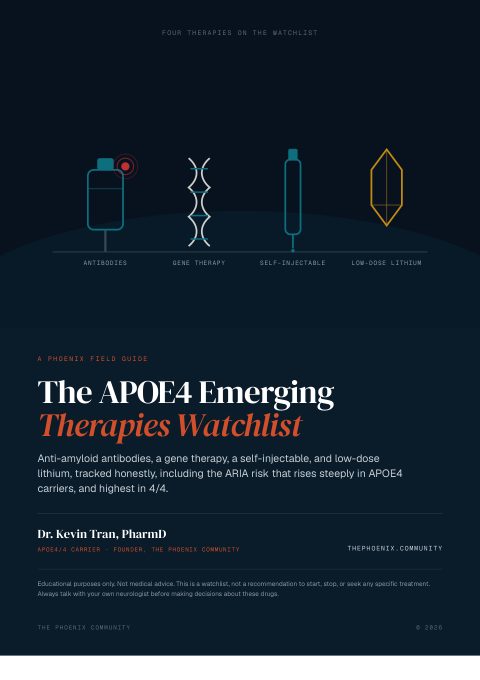
Anti-amyloid drugs are here. Here’s what ARIA risk actually means for APOE4 carriers.
Lecanemab and donanemab are already FDA-approved, and in their pivotal trials, both showed a real, statistically significant slowing of decline. Not a cure. A slowing, and a side effect called ARIA whose risk is not flat across carriers. APOE4/4 carriers have roughly 4.57 times the odds of ARIA-E compared with non-carriers, with rates near 42% in the donanemab genotype breakdown. This free guide walks through what each therapy actually showed, the real ARIA math by genotype, a gene therapy that reported zero ARIA events in its first small trial, and why cleared amyloid on a scan is not the same as a cured brain.
The PDF lands in your inbox in seconds. No spam, only the APOE4 research you’d actually want to hear about.
42%
in APOE4/4 carriers
vs ~13% non-carriers, Zimmer 2025
14 pages · PubMed-cited
The number almost no headline includes
It is not just “these drugs help.” It is what they cost specific carriers.
Two anti-amyloid antibodies are approved and modestly slow decline. Almost no headline mentions that the side-effect risk depends heavily on your genotype, and climbs steepest for APOE4/4.
- Real, modest benefit
The drugs do slow decline, a little
In donanemab’s pivotal trial, the treated group declined about a third more slowly than placebo on a composite cognition and function scale over 18 months (-6.02 vs -9.27). That is real and statistically significant. It is not a cure, and function still declines, just somewhat less quickly.
- A risk that is not flat
ARIA hits some carriers harder than others
These antibodies clear amyloid stuck to blood-vessel walls, which can leave a vessel less stable for a while. APOE4 carriers already show measurable blood-brain-barrier breakdown years before symptoms appear, one reason ARIA lands hardest on APOE4/4 homozygotes.
Risk climbs with every copy of the gene.
What’s inside
The watchlist, sorted by what it means for your genotype.
Every claim is PubMed-cited, sample sizes included, animal and preliminary data clearly labeled.
- 01
Understand ARIA first
What amyloid-related imaging abnormalities actually are, and why APOE4 carriers’ vessels may already be more vulnerable.
The foundation - 02
Lecanemab & donanemab
What the pivotal trials actually showed: a real, modest slowing of decline, and the ARIA rates up front.
FDA-approved - 03
The ARIA risk ladder by genotype
Real numbers for non-carrier, heterozygote, and homozygote, plus what neurologists actually recommend.
The math - 04
LX1001 gene therapy
A structurally different idea: add a protective APOE2 gene instead of clearing plaque. Zero ARIA in its first small trial.
The gene approach - 05
Remternetug & the pipeline
The self-injectable racing toward an at-home prevention trial, and what its early, small ARIA signal shows.
What’s next - 06
Lithium’s surprising second look
A 2025 Harvard study, mouse data that reversed pathology, and exactly how far the human evidence has, and hasn’t, gone.
The wildcard
And what the pipeline can’t promise yet
Cleared plaque is a biomarker headline. Not a promise about how you’ll feel in five years.
A 2026 Cochrane review pooling 17 trials and over 20,000 participants found that removing amyloid from the brain has not been consistently linked to clinically meaningful benefit. The guide holds both things at once: real, modest slowing in the pivotal trials, and a field-wide gap between what clears off a scan and what you would actually notice.
Successful removal of amyloid from the brain does not seem to be associated with clinically meaningful effects.Nonino et al., 2026 · Cochrane review, 17 trials, 20,342 participants

Why I built this
“I am the exact patient these drugs are being built for. Two copies of the gene, no footnote. When I read about ARIA, I do not get to read it as an abstract side-effect column, I read it as my own number, something close to four in ten of us develop it in some form. I built this guide because I wanted the real math before the conversation with my own neurologist, not a press release and not a comment-section panic. I am not telling you to take anything or avoid anything. I am telling you what I actually watch, and why.”
Dr. Kevin Tran · Doctor of Pharmacy · APOE4/4 carrier · Founder
Read my storyYou don’t have to track this pipeline alone
Turn the watchlist into a system that watches for you.
Inside Phoenix, the Clinical Trial Engine tracks trials like the ones in this guide against your own genotype and stage, alongside a pod of carriers having the same conversations.
The Clinical Trial Engine
Matched to your genotype and stage, not a generic feed, so you see the trials that are actually relevant to you.
Bloodwork that speaks APOE4
Your labs read against APOE4-aware ranges, not generic “normal,” so the levers you can pull today sit alongside the drug pipeline you are watching.
Your pod
A small group of fellow carriers, so a decision this weighty is never one you are sitting with alone.
A community that has done the homework
About a third of members are healthcare professionals, all APOE4-focused, who have already had the exact ARIA and genotype conversations in this guide.
Common questions
Frequently asked questions.
What exactly is ARIA, and why does it matter more for APOE4 carriers?
ARIA (amyloid-related imaging abnormalities) shows up on brain MRI as ARIA-E (fluid swelling) or ARIA-H (microhemorrhage). It happens because anti-amyloid antibodies pull amyloid off the walls of small blood vessels, which can leave a vessel less stable for a while. Independent of amyloid or tau, APOE4 carriers show measurable breakdown of the blood-brain barrier years before symptoms appear, which is one reason ARIA can hit carriers, and especially APOE4/4 carriers, harder than everyone else [Montagne et al., 2020].
How much higher is ARIA risk if I am APOE4/4?
In a 2025 secondary analysis of the donanemab trials, ARIA-E occurred in about 42% of APOE4/4 homozygotes versus roughly 11 to 15% of non-carriers, giving homozygotes 4.57 times the odds of non-carriers [Zimmer et al., 2025]. A separate pooled analysis across seven anti-amyloid antibody trials (8,010 people total) found homozygotes had 5.53 times the odds of ARIA-E compared with non-carriers, a consistent pattern across the drug class, not a quirk of one trial [Hsu et al., 2025].
Do the approved drugs, lecanemab and donanemab, actually work?
Yes, modestly. In donanemab’s pivotal trial, the treated group declined about a third more slowly than placebo on a composite cognition and function scale over the 18-month trial (-6.02 vs -9.27) [Sims et al., 2023]. Lecanemab’s pivotal trial showed a similar pattern of real, modest slowing [van Dyck et al., 2022]. But a 2026 Cochrane review pooling 17 trials and over 20,000 participants found that clearing amyloid off a scan does not, by itself, reliably translate into a clinically meaningful benefit [Nonino et al., 2026]. Both things are true at once.
What is LX1001, and is it a safer option than the antibodies?
LX1001 is a gene therapy that adds a working copy of the protective APOE2 gene directly into the fluid around the brain and spinal cord, instead of clearing amyloid plaque. In its small Phase 1/2 trial (15 APOE4/4 homozygotes), no ARIA events were observed and tau biomarkers went down [Johnson et al., 2025]. That is genuinely encouraging, but it is early-stage, open-label data in 15 people, not proof of cognitive benefit or long-term safety.
Should I take lithium for brain health?
The guide does not recommend it, and neither do we. A 2025 Harvard study found lithium is depleted in the brains of people with mild cognitive impairment, and a specific salt, lithium orotate, reversed pathology in mice [Aron et al., 2025]. But no human trial of lithium orotate for Alzheimer’s has been run yet, and a 2025 meta-analysis of six existing lithium trials found current evidence does not support consistent cognitive benefits [Pereira da Silva et al., 2025]. The researchers behind the original study have said explicitly that people should not self-supplement based on mouse data alone.
Get the free guide
You don’t have to watch this pipeline alone.
Enter your email and we’ll send the APOE4 Emerging Therapies Watchlist straight to your inbox, plus the research and member experiments we publish each week.
Straight to your inbox. No spam, only APOE4 research worth your time, and you can leave with one click.
This guide is educational and not medical advice. It covers investigational and recently approved treatments, including anti-amyloid antibodies, gene therapy, and an unapproved supplement (lithium orotate), several with only early-stage, preliminary, or conference-reported human data. Whether any of these therapies is appropriate for you, including genotype testing, eligibility, and ARIA risk, is a decision to make with your own neurologist or physician, not from this guide alone.
Daily protocol
More free guides.
 The APOE4 Sleep & Glymphatic ProtocolExplore sleep research and what it does not yet establish.
 The APOE4 Diet PlaybookCompare dietary approaches and plan what goes on your plate.
 The APOE4 Exercise ProtocolExplore aerobic exercise, higher-intensity sessions and strength training.
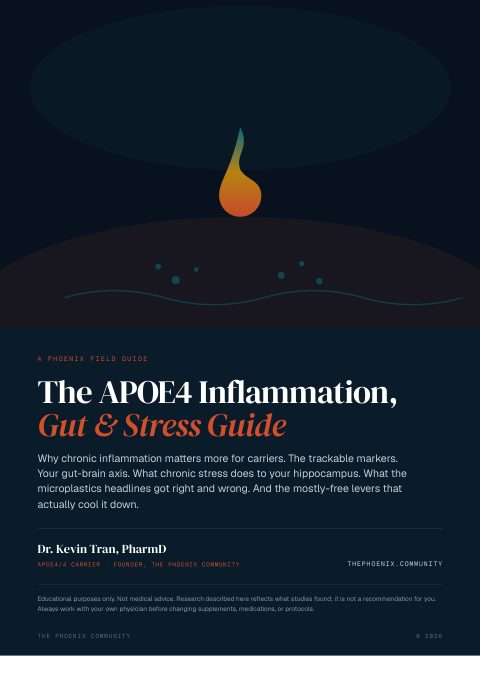 The APOE4 Inflammation, Gut & Stress GuideExplore the research and questions about what to measure.
Phoenix APOE4 ResearchClinical trial engineAPOE4 doctor directory