Guide · For a high, borderline or rising p-tau217
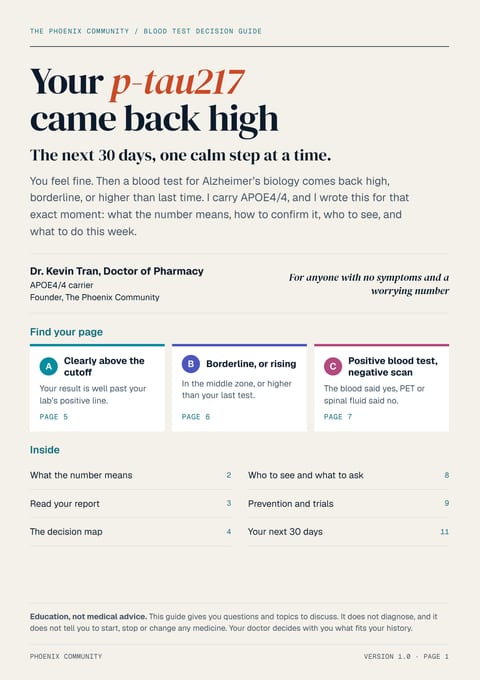
Your p-tau217 came back high. Here’s your next 30 days.
You feel fine. Then a blood test for Alzheimer’s biology comes back high, borderline, or higher than last time. Your result isn’t the end of the story. This guide shows you what the number means, how to confirm it, who to see, and what to do this week. Find your branch, take one calm step at a time, and bring the questions to your doctor.
Instant download. No spam, only the APOE4 research you’d actually want to hear about.
13.4%
had a positive p-tau217 with a negative amyloid test
Kjaergaard et al., 2026
14 pages · 26 sources
What the number means
A high result is a signal. It is not a diagnosis.
p-tau217 is a blood marker that tracks Alzheimer’s changes in the brain, mostly amyloid plaques. It deserves a proper follow-up. It does not mean you have dementia, or that you will.
- What it does mean
A real signal worth confirming
In people without symptoms who had amyloid, a higher p-tau217 predicted faster decline on memory and thinking tests over about six years [Mattsson-Carlgren et al., 2023]. Whether amyloid is really there is the next question, and it can be answered.
- What it does not mean
“At risk”, not diagnosed
An International Working Group of experts recommends that people with positive biomarkers and no symptoms be called “at risk”, not diagnosed with Alzheimer’s, because most will not develop symptoms in the near term [Dubois et al., 2024].
A positive blood test with a negative scan happens more often than people think.
What’s inside
Find your branch. Then take one calm step at a time.
Every number is checked against the study on PubMed. Where a study was done in people with symptoms, or did not look at APOE type, the guide says so.
- 01
Read your report before you react
The lab, the cutoff, your zone, your kidney function and your symptoms: five things to find first.
Page 3 - 02
The decision map
One page that sends you to your branch, and the steps every branch shares.
Page 4 - 03
Branch A · Clearly positive
Why to confirm with amyloid PET or spinal fluid before any big decision, and what to ask the specialist.
Page 5 - 04
Branch B · Borderline or rising
Retest, add a second test, or go to PET or spinal fluid, and how large a change has to be to count.
Page 6 - 05
Branch C · Positive blood, negative scan
Three possible reasons, what to do now, and the questions to bring to your specialist.
Page 7 - 06
Who to see and what to ask
Who does what, what to say when you book, and the questions to bring.
Page 8 - 07
Prevention and trials, honestly
What the lifestyle and blood pressure trials found, and which prevention trials take people without symptoms.
Pages 9 and 10 - 08
Your next 30 days
A week-by-week checklist and a page to fill in and take to your appointments.
Pages 11 and 12
Want the basics of each marker first? The Brain Biomarker Guide explains them. This guide starts where that one stops: you already have a number.
And a rule worth borrowing
“No big decisions in the first 48 hours.” Read, write your questions down, and sleep on it.
In the AHEAD trial screening, 3,414 people without symptoms learned their amyloid result and their APOE type. Average distress stayed below clinically significant levels [Grill et al., 2026]. The guide gives you the order to take it in.
A negative scan is real information. Plaques are not showing on PET today. Use that time well: look after the levers you control, and retest on a schedule you agreed.From the guide · Branch C, positive blood test, negative scan

Why I built this
“You feel fine. Then a blood test for Alzheimer’s biology comes back high, borderline, or higher than last time. I carry APOE4/4, and I wrote this for that exact moment: what the number means, how to confirm it, who to see, and what to do this week. That’s all you have to do this month to be ahead.”
Dr. Kevin Tran, Doctor of Pharmacy, I carry APOE4/4 · Founder
Read my storyYou don’t have to do this alone
Know what to do next, and whether it’s working.
Phoenix is one home for APOE4: your personal protocol, your bloodwork read against APOE4 ranges, and people who get it.
Your personal protocol, built around you
Know which change to make first for your genes and your numbers, and what to try next.
Optimize your bloodwork for APOE4
Upload any lab report, see your changes over time, and keep your next blood test on the calendar.
Find clinical trials that fit your profile
Our Clinical Trial Engine lists APOE4-relevant studies by location and recruitment status, in plain English.
Keep going with people who get it
5,000+ APOE4 carriers in a private community, with expert Q&As and your pod.
Common questions
Frequently asked questions.
Does a high p-tau217 mean I have Alzheimer’s?
No. It is a signal that often goes with amyloid in the brain, and it deserves a proper follow-up. An International Working Group of experts recommends that people with positive biomarkers and no symptoms be called “at risk”, not diagnosed with Alzheimer’s, because most will not develop symptoms in the near term [Dubois et al., 2024]. Whether amyloid is really there can be confirmed with amyloid PET or spinal fluid.
Can I compare my number with a result from another lab?
No. Several companies measure p-tau217, each with its own units and cutoff, so a number from one lab cannot be compared with a number from another. Retest with the same lab and the same test. In memory clinic patients tested three times within about five weeks, a change had to be roughly 15 to 40%, depending on the marker, before it was more than normal variation [Clemmensen et al., 2025].
My blood test was positive but my PET scan was negative. Which one do I trust?
For now, treat the scan or spinal fluid result as the stronger evidence. This happens more often than people think: in a memory clinic study of 539 patients, 13.4% had a positive p-tau217 with a negative amyloid test [Kjaergaard et al., 2026]. Very early amyloid, lower kidney function, older age, thyroid disease or the test itself can explain it [Shir et al., 2026]. Agree a retest date with the same lab.
Can my kidneys change my p-tau217 result?
Yes. In a community study, chronic kidney disease raised p-tau217 by about as much as brain amyloid did [Mielke et al., 2022]. With normal or mildly reduced kidney function, the effect was small [Pichet Binette et al., 2023]. That is why the guide asks you to find your kidney function (eGFR) before you react to the number.
Is there a treatment if I have amyloid and no symptoms?
No drug is approved for people with amyloid and no symptoms. Leqembi and Kisunla are approved for early Alzheimer’s with symptoms and confirmed amyloid. Prevention trials such as AHEAD 3-45 and TRAILBLAZER-ALZ 3 enroll people without symptoms [Rafii et al., 2023, Yaari et al., 2025]. In the US POINTER trial, a structured lifestyle program improved overall thinking, and the benefit was similar in APOE4 carriers and non-carriers [Baker et al., 2025].
Get the guide
Thirty days. One calm step at a time.
Enter your email and download Your p-tau217 Came Back High: The Next 30 Days straight away, plus the research and member experiments we publish each week.
Instant download. No spam, and you can leave with one click.
Education, not medical advice. This guide gives you questions and topics to discuss. It does not diagnose, and it does not tell you to start, stop or change any medicine. Your doctor decides with you what fits your history. New or worsening memory problems? See your doctor promptly.
Bloodwork & biomarkers
More free guides.
 The APOE4 Blood Work BlueprintPrepare a bloodwork checklist for your doctor.
 The APOE4 Brain Biomarker GuideUnderstand what brain-related blood tests can and cannot tell you.
 The APOE4 Lipid PlaybookUnderstand cholesterol markers and questions about treatment.
 The APOE4 Metabolic GuideExplore glucose, insulin, fasting and metabolic treatments.
Phoenix APOE4 ResearchClinical trial engineAPOE4 doctor directory