Free guide · For APOE4 carriers
Blood tests like pTau-217 now catch what used to require a spinal tap or a PET scan.
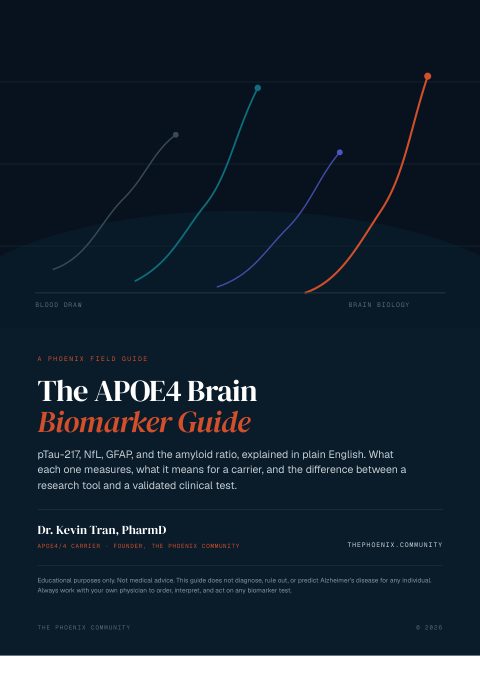
For decades, the only way to see Alzheimer’s biology in a living person was an invasive spinal tap or an expensive PET scan, and most doctors never ordered either one. Between 2018 and 2025, four blood markers, pTau-217, NfL, GFAP, and the amyloid 42/40 ratio, went from lab curiosities to tests a real lab can run. One of them earned the FDA’s first clearance for Alzheimer’s in May 2025. This free guide walks through what each marker actually measures, why the same test name can give two different answers depending on the assay, and the one distinction that matters most: research tool versus validated clinical test.
The PDF lands in your inbox in seconds. No spam, only the APOE4 research you’d actually want to hear about.
91.7%
positive-result match rate
n=499, Hu et al., 2025
16 pages · PubMed-cited
The reframe almost nobody explains clearly
Same marker name. Not the same test.
A biomarker result feels like a fact on a page. The honest version is more useful: what it measures, which version of the test produced it, and what the number can and cannot tell you.
- Same name, different assay
Not all pTau-217 tests agree
At least ten different pTau-217 assays exist. In a head-to-head comparison on the same 135 patients’ blood, the best performers reached accuracy in the high 0.80s to high 0.90s, while others scored as low as 0.64, on identical samples.
- Information, not a verdict
Research tool vs. clinical test
The FDA’s 2025 clearance covers symptomatic adults 55 and older, as one piece of a full workup, not a stand-alone diagnosis. Most pTau-217, GFAP, and NfL testing today is still research-grade.
It matched the gold-standard scan almost every time.
What’s inside
Sorted honestly, by the strength of the evidence.
Every claim is PubMed-cited, sample sizes included, and research-grade tests are clearly labeled apart from clinical ones.
- 01
pTau-217, the marker that broke through
Why one blood marker earned the FDA’s first Alzheimer’s clearance, and what the study behind it actually tested.
The breakthrough - 02
The cutoff confusion no one warns you about
Why the same test name from two labs can give two different answers, and the one question to ask before you test.
The catch - 03
NfL, the smoke alarm that can’t name the fire
A general nerve-damage signal, useful as a trend line, honest about not being Alzheimer’s-specific.
The trend marker - 04
GFAP, the early warning from support cells
What your brain’s support cells signal early, and why the biology may matter more for APOE4 carriers.
The early signal - 05
Research tool, or clinical test?
The single distinction that protects you from over-trusting or over-fearing any one number.
The distinction - 06
A script for your doctor’s appointment
The exact words to bring to the visit, and the four questions worth asking before you order anything.
The script
And the myths worth dropping
A clean result does not mean completely in the clear.
The guide walks through the myths carriers repeat most often, including the one about a “clean” panel: even the FDA-cleared test still misses some true cases and flags some false ones, in its own validation study.
A biomarker is information, not a verdict. You get to decide what you do with the information, and you do not have to decide alone.From the guide · the rule for reading any number

Why I built this
“I remember the first time I saw my own pTau-217 number, sitting there with no context, next to a cutoff I did not fully understand. I am a Doctor of Pharmacy, and even I had to sit with it for a while before it made sense. This guide is the plain-English version I wish existed that day: what each marker means, what it does not, and when a number is worth a real conversation with a doctor instead of a search engine at midnight.”
Dr. Kevin Tran · Doctor of Pharmacy · APOE4/4 carrier · Founder
Read my storyYou don’t have to read the number alone
Turn a lab report into context you can actually use.
Inside Phoenix, biomarker results get tracked against APOE4-aware context over time, alongside a pod of carriers who have had the exact same conversation.
Your pod
Matched to fellow APOE4 carriers, so a number you don’t know how to read never has to sit with you alone at midnight.
Bloodwork that speaks APOE4
Upload your labs and track 27 APOE4-aware biomarkers against carrier-specific targets, not generic “normal” ranges.
Trends, not a single verdict
See your own numbers move over time instead of reading one result in isolation.
A community that has done the homework
About a third of members are healthcare professionals, and the whole community has had the exact assay, cutoff, and “what does this mean” conversations in this guide.
Common questions
Frequently asked questions.
Can a blood test actually diagnose Alzheimer’s?
No single test does that alone, not even the FDA-cleared one. The Lumipulse pTau217/amyloid ratio test cleared in May 2025 is validated only for symptomatic adults age 55 and older, as one piece of a full clinical workup, not a stand-alone verdict. In its own validation study of 499 people, it still missed about 8% of true positives and flagged about 3% of true negatives. Excellent for a blood test, not the same as certainty.
Why do different pTau-217 tests give different answers on the same blood?
Because at least ten different pTau-217 assays exist, built by different labs with different antibodies and reference ranges. In a head-to-head comparison of ten assays run on the same 135 patients’ blood, the best performers reached accuracy in the high 0.80s to high 0.90s, while others scored as low as 0.64, on identical samples. A result only makes sense next to the specific assay and cutoff that produced it.
What does NfL actually tell me?
NfL flags nerve-cell damage, but it is not specific to Alzheimer’s. It also rises with multiple sclerosis, stroke, Parkinson’s, and normal aging. It is most useful as a trend line against your own baseline over time, paired with a more specific marker like pTau-217, rather than read alone.
Is GFAP, or a brain-age test, the same as a diagnosis?
No. Both are strong, genuinely interesting research signals, GFAP reaches a diagnostic accuracy (AUC) of 0.87 in a combined model predicting progression to dementia, and it may matter even more for APOE4 carriers specifically. Neither GFAP nor a brain-age clock is a stand-alone, FDA-cleared clinical test today.
Should I test my biomarkers if I have no symptoms?
Most of what is in the guide is not built or validated to predict an individual’s future when they have no symptoms. The honest framing is tracking a trend over time with your doctor, not finding out your fate. The guide walks through the exact questions worth asking before you order anything, including which assay the lab uses and what happens next if a result is concerning.
Get the free guide
A number is a start. Not the whole story.
Enter your email and we’ll send the APOE4 Brain Biomarker Guide straight to your inbox, plus the research and member experiments we publish each week.
Straight to your inbox. No spam, only APOE4 research worth your time, and you can leave with one click.
This guide is educational and not medical advice. It does not diagnose, rule out, or predict Alzheimer’s disease for any individual, and most of the markers covered are research tools rather than validated diagnostic tests. Always work with your own physician, and where relevant a neurologist or memory-clinic specialist, before ordering, interpreting, or acting on any Alzheimer’s blood biomarker.
Bloodwork & biomarkers
More free guides.
 The APOE4 Blood Work BlueprintPrepare a bloodwork checklist for your doctor.
 The APOE4 Lipid PlaybookUnderstand cholesterol markers and questions about treatment.
 The APOE4 Metabolic GuideExplore glucose, insulin, fasting and metabolic treatments.
Phoenix APOE4 ResearchClinical trial engineAPOE4 doctor directory