Free guide · For APOE4 carriers
Your LDL looks fine. Your ApoB doesn’t.
You can have a “normal” cholesterol panel and a quietly high number of the particles that actually build plaque. That number is ApoB. And it matters more than LDL, especially for APOE4 carriers. This free Playbook shows you how the 90 / 70 / 60 mg/dL cardiovascular risk tiers work, the levers from food to medicine, and how I cut my own ApoB from 115 to 70 without a statin.
The PDF lands in your inbox in seconds. No spam, only the APOE4 research you’d actually want to hear about.

115 → 70
From 115 to 70 mg/dL
16 pages · PubMed-cited
Why LDL is the wrong number
Cholesterol is the cargo. ApoB is the truck count.
LDL measures how much cholesterol rides in your blood. But it is the number of particles, not the cholesterol inside them, that gets stuck in your artery wall and starts a plaque. Almost every plaque-building particle carries exactly one ApoB. Count the trucks, not the cargo.
- The discordance problem
Same LDL, different risk
Two people with an identical LDL can carry a very different number of particles. When LDL and ApoB disagree, your risk follows ApoB. And low triglycerides can hide a high particle count. Mine did.
- The APOE4 problem
Your gene runs your lipids higher
APOE4 clears LDL particles more slowly, so carriers tend to run higher ApoB. In our own members, two-copy carriers average a higher ApoB than one-copy carriers, exactly as the research predicts.
Know your cardiovascular risk tier.
Suggested treatment-intensification thresholds · 2024 National Lipid Association consensus · not genotype targets.
What’s inside
One number. A clear plan to move it.
Every claim is PubMed-cited, and the charts use real anonymized data from hundreds of APOE4 carriers in the Phoenix community.
- 01
ApoB, not LDL
Why one number beats the whole cholesterol panel, and why low triglycerides can fool you.
The core idea - 02
Heart and brain
Why lowering ApoB protects two organs at once, and the APOE4 lipid gradient in our own data.
The stakes - 03
Your risk map
How the 90 / 70 / 60 mg/dL thresholds map to cardiovascular risk, why APOE4 alone does not set your tier, and why lower-for-longer matters.
The aim - 04
The levers, in order
Diet, fiber, and exercise first, with how far each one actually moves your number.
Food first - 05
The medication decision
Statin vs ezetimibe vs PCSK9 vs bempedoic acid: in plain English, with the brain-safety answer.
When you need it - 06
Your 90-day plan
Measure, pull a few levers, re-test: the simplest way to watch your number fall.
The runway
“But will a statin hurt my brain?”
The question every carrier asks. Answered honestly.
A review of 36 studies found statin users had no increase in dementia or Alzheimer’s risk, and if anything a lower rate. The Playbook walks every option, including the non-statin path I used, so you and your doctor can choose with the evidence in front of you.
The first time you watch your own ApoB drop, the fear becomes a project. And the project starts working.Dr. Kevin Tran · APOE4/4 · Founder

Why I built this
“When I got my own results, my ApoB was 115, well above the cardiovascular range I had reviewed. I cut it to 70 without a statin, using food, fiber, exercise, and a non-statin medicine. This is the playbook I wish someone had handed me, and I’m giving it to you free.”
Dr. Kevin Tran · Doctor of Pharmacy · APOE4/4 carrier · Founder
Read my storyFrom numbers to action
Knowing your ApoB is 10% of the battle.
The real question is what moves it. Inside Phoenix, you don’t guess alone. You see what actually lowered ApoB for carriers who share your genetics, and track yours against APOE4-aware ranges over time.
Bloodwork that speaks APOE4
Upload your labs and see your ApoB and full panel against APOE4-aware targets, not generic “normal,” with trends tracked automatically.
Build the full evidence trail
Record diet, fiber, exercise, medication, timing, and adherence beside real ApoB movement.
Structured experiments
Record every intervention, measure before and after, and retest at the right interval. Phoenix is building pooled analysis to help separate what is helping from what is not.
People who get it
Hundreds of APOE4 carriers sharing protocols and results: about a third are healthcare professionals.
Common questions
Frequently asked questions.
Why does ApoB matter more than LDL for APOE4 carriers?
LDL measures how much cholesterol rides in your blood, but it is the number of particles, not the cholesterol inside them, that gets stuck in an artery wall and starts a plaque. Almost every plaque-building particle carries exactly one ApoB, so it counts the particles directly. APOE4 also clears LDL particles more slowly, so carriers tend to run a higher ApoB than their LDL alone would suggest.
How do the 90 / 70 / 60 mg/dL ApoB thresholds work?
The 2024 National Lipid Association consensus suggests 90 mg/dL for borderline or intermediate cardiovascular risk, 70 mg/dL for high risk, and 60 mg/dL for very-high-risk ASCVD as thresholds for considering treatment intensification. They are risk-tier thresholds, not APOE genotype targets.
Will a statin hurt my brain?
The Playbook reviews a meta-analysis of 36 studies that found statin users had no increase in dementia or Alzheimer's risk, and if anything a slightly lower rate. It also walks through non-statin options, including the levers Dr. Kevin Tran used to lower his own ApoB from 115 to 70 without one, so you and your doctor can choose with the evidence in front of you.
What if diet and exercise alone don't move my ApoB enough?
The Playbook covers the full decision in plain English: statin vs ezetimibe vs PCSK9 inhibitor vs bempedoic acid, including how each works and the brain-safety evidence for each option.
Are these APOE4 genotype targets?
No. APOE4 is relevant context, but your full cardiovascular risk tier, not genotype alone, should guide the treatment conversation with your clinician. This guide is educational and not medical advice.
Get the free guide
Stop guessing. Get your ApoB down.
Enter your email and we’ll send the APOE4 Lipid Playbook straight to your inbox, plus the research and member experiments we publish each week.
Straight to your inbox. No spam, only APOE4 research worth your time, and you can leave with one click.
This guide is educational and not medical advice. The 90 / 70 / 60 mg/dL values are cardiovascular risk-tier thresholds for considering treatment intensification, not APOE genotype targets. Your clinician should set your individual target using your full cardiovascular risk and treatment context. Lipid medications have benefits and risks specific to you.
Bloodwork & biomarkers
More free guides.
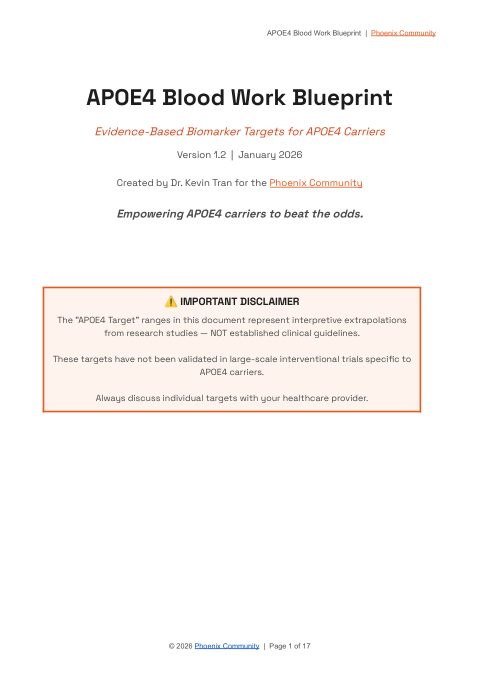 The APOE4 Blood Work BlueprintPrepare a bloodwork checklist for your doctor.
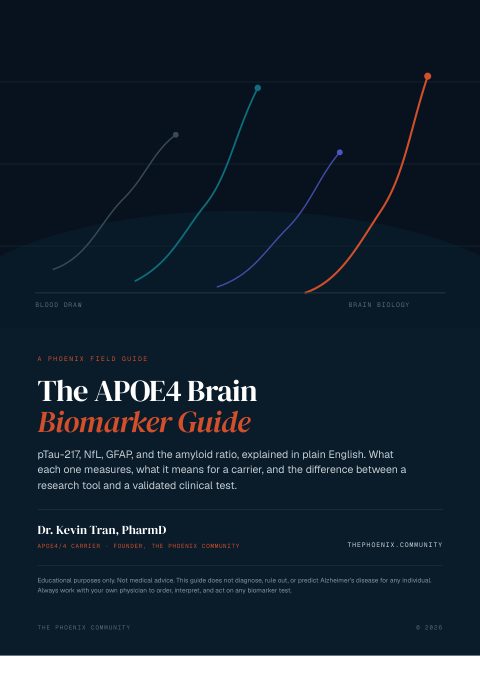 The APOE4 Brain Biomarker GuideUnderstand what brain-related blood tests can and cannot tell you.
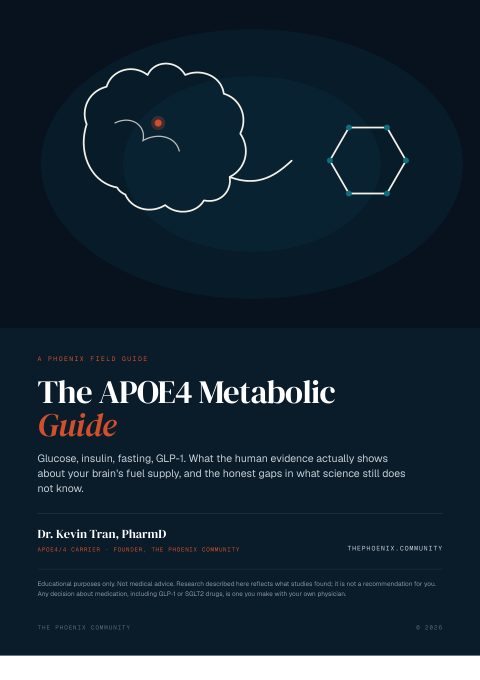 The APOE4 Metabolic GuideExplore glucose, insulin, fasting and metabolic treatments.
Phoenix APOE4 ResearchClinical trial engineAPOE4 doctor directory