Free clinical reference · For GPs, internists, neurologists, cardiologists, gynaecologists
Your patient has twelve minutes with you and a printout you didn’t order.
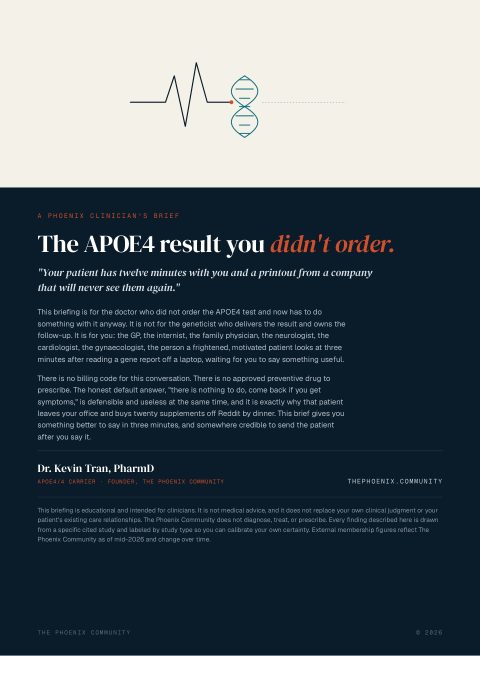
This briefing is for the doctor who did not order the APOE4 test and now has to do something with it anyway. There is no billing code for this conversation and no approved preventive drug. “Come back if you get symptoms” is defensible and useless at the same time. This brief gives you something better to say in three minutes, grounded in the 2024 Lancet Commission reframe: APOE4 is a lipid gene, and the largest modifiable lever is one you already treat.
The PDF lands in your inbox in seconds. No spam, only the APOE4 research you’d actually want to hear about.
45%
of dementia potentially modifiable
LDL cholesterol, tied largest, is new
20 pages · PubMed-cited
What the twelve minutes actually needs
A number to frame, and a reframe that changes the visit.
A frightened, motivated patient looks at you three minutes after reading a gene report off a laptop. The brief is built to be accurate enough that you trust it, and short enough to use today.
- Risk, not destiny
Dose-dependent, not deterministic
By age 85, lifetime AD risk runs roughly 11–14% with no reference to genotype, 23–30% for one copy, 51–60% for two copies. Even at the highest line, roughly 4 in 10 homozygous carriers will not develop the disease.
- The reframe
APOE4 is a lipid gene
Its protein moves cholesterol and lipids in the brain. High LDL is now tied for the single largest midlife modifiable dementia risk factor. That is not a coincidence you need to explain, just say the plain version.
Two factors, tied at the top of the list.
What’s inside
Accurate enough to trust. Fast enough to use today.
Every clinical claim is PubMed-verified, with non-significant results stated plainly, not smoothed over.
- 01
What the result means
Lifetime AD risk by genotype and sex, from a 7,351-case pooled analysis.
Reference - 02
What is modifiable
The 2024 Lancet Commission’s 14 factors, and the independent replication caveat.
The 45% - 03
The reframe
Why APOE4 being a lipid gene is the single most useful sentence you can say.
The idea - 04
The levers you already manage
Blood pressure, activity, hearing, diabetes drug class, lipids, sleep apnea, ranked by evidence.
Action - 05
What to measure
Lipid panel + ApoB, HbA1c, BP, hearing, and where plasma p-tau217 fits.
Orders - 06
The traps
No approved preventive drug, ARIA risk by genotype, DTC false positives, and GINA’s real gaps.
Guardrails
A companion for your patient
The same evidence base, written for the other chair.
Phoenix’s Doctor Conversation Kit gives your patient the carrier-facing version of this exact reframe, so the visit starts with a request you already know how to fulfill.
The gene your patient is afraid of is a lipid gene. The tool with the largest modifiable share of midlife dementia risk is lipid control. That is not an untreatable genetic verdict. It is a risk multiplier sitting on top of things you already treat.From the brief · the reframe

Why I built this
“There is no billing code for the conversation a frightened, motivated patient wants to have with you. I built this brief so you have something better to say than ‘there’s nothing to do,’ in the twelve minutes you actually have.”
Dr. Kevin Tran · Doctor of Pharmacy · APOE4/4 carrier · Founder
Read my storyA resource for your patients
Where to send a carrier who wants more than twelve minutes.
Phoenix does not diagnose, treat, or prescribe, and defers explicitly to the carrier’s own physician. It closes the gap between this visit and the next one.
APOE4-aware bloodwork
Members upload labs and see them read against carrier-specific ranges, not generic “normal.”
Structured tracking
Diet, sleep, exercise, and supplement changes get linked to real biomarker movement over time.
Peer support
Small pods of fellow carriers, matched monthly, so isolation turns into people who understand the result.
A credible community
About 32% of members are healthcare professionals themselves, a real trust signal, not a wellness fad.
Common questions
Frequently asked questions.
What did the 2024 Lancet Commission actually add to the modifiable-risk model?
High LDL cholesterol and untreated vision loss were added in the 2024 update. LDL cholesterol is now tied with hearing loss as the single largest midlife modifiable dementia risk factor at 7% population attributable fraction, out of 14 factors totaling an estimated 45% of dementia cases. The brief also flags an independent replication that found a narrower ~40% estimate.
What can I actually say to a patient in three minutes?
The brief gives you the reframe verbatim: APOE4 is a lipid-handling gene, and the largest modifiable dementia risk factor doctors currently have is lipid control, alongside hearing. That turns "there is nothing to do" into a request for a lipid panel, blood pressure check, and hearing screen, tools you already have.
How much higher is the ARIA risk in APOE4 homozygotes on anti-amyloid therapy?
A meta-analysis of 6 randomized trials (n=5,633) found ARIA-E roughly 2.2x more common and ARIA-H roughly 3.5x more common in APOE4 carriers than non-carriers, with homozygous carriers at the highest risk within that group, and the smallest cognitive benefit. These drugs are approved only for symptomatic, biomarker-confirmed early Alzheimer's, not as a preventive for an asymptomatic carrier.
Does GINA protect my patient's insurance?
Only partly, and only in the US. GINA prohibits genetic discrimination in health insurance and employment, but it explicitly does not cover life, disability, or long-term-care insurance. The brief covers this so you can flag it before a patient pursues formal testing.
Does the FINGER trial show APOE4 carriers benefit more from lifestyle intervention?
No, and the brief is precise about this. Carriers showed a numerically larger cognitive improvement in a subgroup analysis, but the carrier-vs-noncarrier interaction was not statistically significant. The accurate claim is that carriers respond at least as well as non-carriers, not that they benefit more.
Get the free brief
Keep it on the desk. Use it in the visit.
Enter your email and we’ll send The Clinician’s APOE4 Brief straight to your inbox, plus the research updates we publish for clinicians.
Straight to your inbox. No spam, only APOE4 research worth your time, and you can leave with one click.
This briefing is educational and intended for clinicians. It is not medical advice and does not replace your clinical judgment or the patient’s existing care relationships. The Phoenix Community does not diagnose, treat, or prescribe. Findings are labeled by study type; non-significant results are stated as such. GINA content is US-law specific.
Family & doctors
More free guides.
 APOE4 Genetic Testing & Family GuidePrepare for testing decisions and family conversations.
 The APOE4 Brief for Genetic CounselorsFind a professional reference for discussing APOE4 results.
 The Doctor Conversation KitPrepare your questions and take a one-page brief to your appointment.
 The Caregiver’s 90-Day PlanPlan the first months after a parent or partner is diagnosed.
Phoenix APOE4 ResearchClinical trial engineAPOE4 doctor directory