Free guide · For caregivers of a parent or spouse with Alzheimer’s
You didn’t sign up for this. You’re still the right person for it.
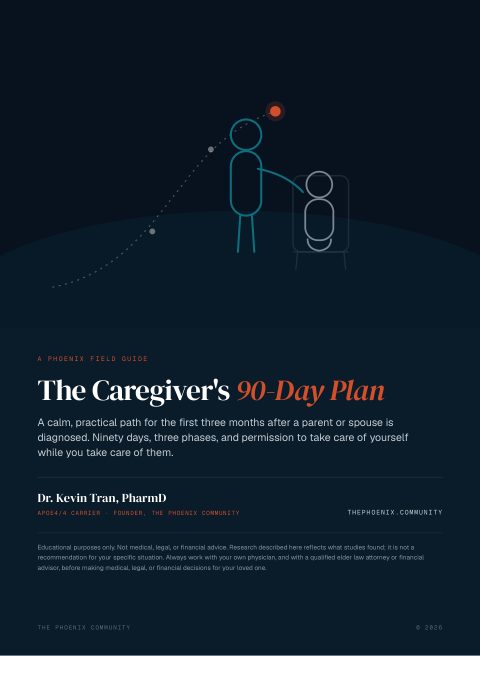
Somebody you love got a diagnosis, and somewhere in that appointment, without anyone asking if you were ready, you became a caregiver. This free guide breaks the next ninety days into three phases: stabilizing the home and the medical team first, then a tested daily routine and a page most caregivers are never given about your own risk, then the support that keeps you from running yourself into the ground. Every recommendation is sourced to the trial or cohort behind it, including where the evidence is honestly mixed.
The PDF lands in your inbox in seconds. No spam, only the APOE4 research you’d actually want to hear about.
29%
vs. ~14%
Duara et al., 1996
15 pages · PubMed-cited
The page almost no caregiver guide includes
This isn’t only about the person you’re caring for. It may be about you too.
Most caregiving advice stops at logistics. One part of this guide goes further, because if a parent has Alzheimer’s, the person caring for them may be carrying more than grief.
- How the gene actually travels
You may not just be watching this happen
APOE is inherited from each parent in a semi-dominant pattern. If your parent carries an APOE4 allele, each of their biological children has a real, calculable chance of carrying that same copy, whether or not they ever show symptoms [Genin et al., 2011].
- Carrying the gene isn’t a locked door
Carriers may benefit at least as much from acting early
In a large randomized trial combining diet, exercise, cognitive training, and metabolic management, APOE4 carriers responded to the combined program at least as well as non-carriers, with a numerically larger benefit in carriers [Solomon et al., 2018].
Family history and APOE4 status travel together more than chance alone predicts.
What’s inside
Three phases, in the order they actually matter.
Every recommendation is PubMed-cited, sample sizes included, and honest about where the evidence is still thin.
- 01
Make the home safer, not perfect
The five places most falls and 3am scares come from, fixed in one focused afternoon.
Days 1–30 - 02
Build the medical team
Who belongs on it, and why facing this alone is a documented risk factor, not just a feeling.
Days 1–30 - 03
The papers that cannot wait
Power of attorney, healthcare proxy, and a legal-capacity window that closes faster than you’d expect.
Days 1–30 - 04
Build a routine that helps them
A tested daily rhythm that reduced symptoms in one trial and caregiver burden in both.
Days 31–60 - 05
Protect your own brain
The page most caregivers are never given: what your parent’s diagnosis may mean for your own risk.
Days 31–60 - 06
Respite, community, and the long game
The honest research on rest, the warning signs of burnout, and why isolation is measurable, not just a feeling.
Days 61–90
And the myths worth dropping
“I have to figure this out alone.” You don’t, and the research backs that up.
The guide closes with a myths-versus-reality table: what the respite-care research actually shows, why the legal papers cannot wait, and why your own genetic risk is relevant now, not someday.
You cannot pour from an empty cup, and you cannot out-caregive a body and mind that never gets to rest. Taking care of yourself is not the thing that competes with taking care of them. It is what makes it possible.From the guide · on protecting yourself while you protect them

Why I built this
“I call myself a caregiver’s kid before I call myself a founder. I know what it is to watch someone you love get a diagnosis and have nowhere to put the fear except into the next small task. This is the plan I wish someone had handed me on day one: not instead of caring for them, alongside it, because you matter in this story too.”
Dr. Kevin Tran · Doctor of Pharmacy · APOE4/4 carrier · Founder
Read my storyYou don’t have to hold this alone
Practical support for the person you care for.
Find clearer answers and practical support for the person you care for. Explore relevant research, clinical trials and doctors who understand APOE4.
Support from people who understand
Find practical support and learn from other members’ experience as you care for someone you love.
Understand their bloodwork
Use APOE4 research to understand their bloodwork and prepare clearer questions for their doctor.
Start with their needs
Explore knowledgeable doctors and relevant clinical trials for the person you care for, when you are ready.
Learn from member experience
Learn from earlier and current member experiments. Bring better questions to the people involved in their care.
Common questions
Frequently asked questions.
I am not an APOE4 carrier myself. Is this guide still for me?
Yes. It is written for anyone caring for a parent or spouse through a diagnosis, whether or not you know your own genetic status. The home-safety, medical-team, and legal-document sections apply regardless. One section (Days 31 to 60) also explains why, if a parent carries an APOE4 allele, each of their biological children has a real, calculable chance of carrying that same copy, since APOE is inherited from each parent in a semi-dominant pattern [Genin et al., 2011].
Do home modifications actually reduce falls, or is that just assumed?
A systematic review found strong evidence that home modifications reduce fall rates and fall risk in older adults, with moderate evidence they also improve the caregiving experience for families managing dementia [Stark et al., 2017]. That is why the guide starts with a focused, five-area home-safety pass in week one, not a full renovation.
Does respite care actually reduce caregiver stress?
The guide is honest that the evidence is mixed. A Cochrane review of four randomized trials found no statistically significant benefit of respite care on caregiver burden or stress, though the review authors rated the overall evidence quality as very low, largely because so few well-designed trials exist [Maayan et al., 2014]. What the research does show clearly is that unrelieved caregiver strain carries real, measured health risk, which is why the guide treats respite as worth booking even without a guarantee it lowers stress on paper.
Is a daily routine really backed by research, or is that just intuitive advice?
In a randomized trial, caregivers who built tailored daily routines around what their loved one could still do saw significant reductions in agitation, anxiety, and sleep disruption, along with lower caregiver burden [de Oliveira et al., 2018]. A larger follow-up trial of 250 caregiving pairs did not replicate those specific symptom reductions, but did find caregiver wellbeing improved and hospitalizations dropped by nearly half over six months [Gitlin et al., 2021].
What is the single most time-sensitive thing in the guide?
Two things share that spot: getting power of attorney and healthcare proxy documents signed while your loved one still has the legal capacity to sign them, since that capacity can decline faster than expected, and putting your own baseline genetic and biomarker testing on your calendar within thirty days, because your parent's diagnosis may be the clearest signal you will ever get that it is worth checking.
Get the free guide
Ninety days. One plan you don’t have to build alone.
Enter your email and we’ll send the Caregiver’s 90-Day Plan straight to your inbox, plus the research and member experiments we publish each week.
Straight to your inbox. No spam, only APOE4 research worth your time, and you can leave with one click.
This guide is educational and not medical, legal, or financial advice. It describes general practices and what the research has found, not a recommendation for your specific situation. Some of the research on respite care and daily routines cited inside is small or mixed, and we say so plainly rather than smoothing it over. Always work with your loved one’s own physician, and with a qualified elder law attorney or financial advisor, before making medical, legal, or financial decisions for them or for yourself.
Family & doctors
More free guides.
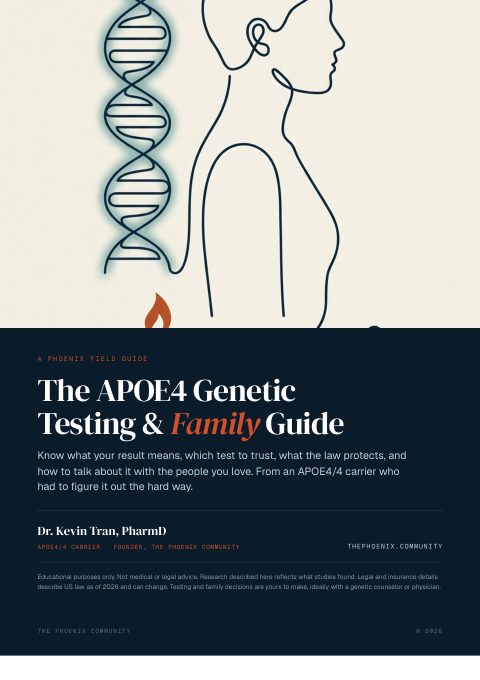 APOE4 Genetic Testing & Family GuidePrepare for testing decisions and family conversations.
 The APOE4 Brief for Genetic CounselorsFind a professional reference for discussing APOE4 results.
 The Clinician’s APOE4 BriefBring a focused APOE4 reference into clinical conversations.
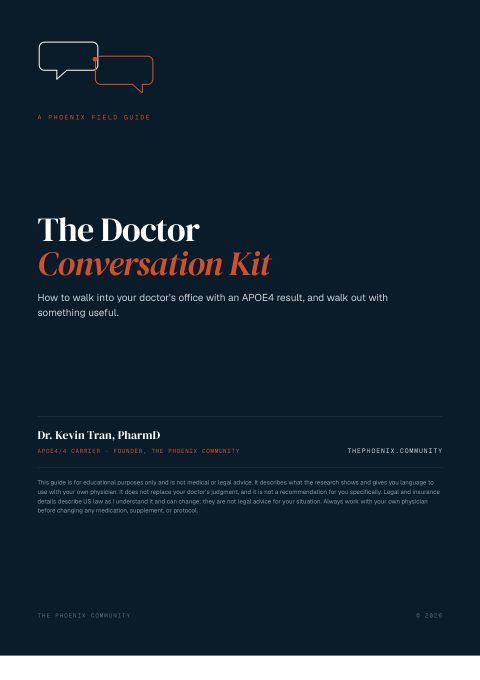 The Doctor Conversation KitPrepare your questions and take a one-page brief to your appointment.
Phoenix APOE4 ResearchClinical trial engineAPOE4 doctor directory