Free guide · For APOE4 carriers
You carry APOE4. It loads the dice. It doesn’t throw them.
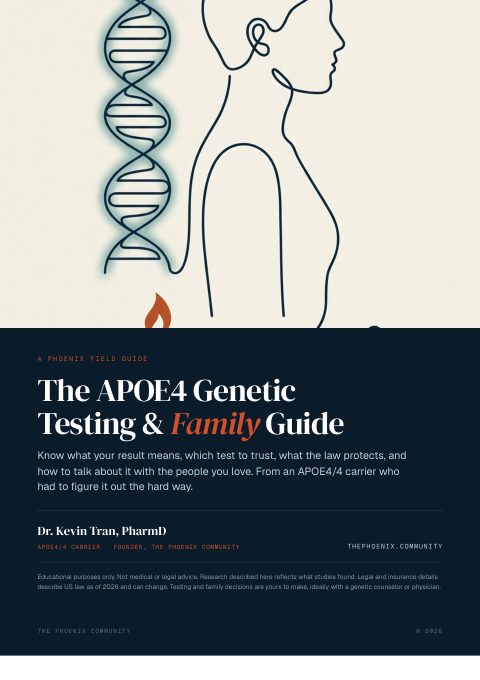
The day I learned I was APOE4/4, the room got smaller. I did the math on my future in four seconds flat. Then I learned what the number actually means. And that even most two-copy carriers do not develop the disease. This free guide decodes your genotype, the real risk numbers, the testing maze, and the family conversation.
The PDF lands in your inbox in seconds. No spam, only the APOE4 research you’d actually want to hear about.
~40%
stay AD-free
most of it is yours to influence
13 pages · PubMed-cited
Two things nobody explains
A result is not a sentence. And one copy is not two.
Direct-to-consumer testing put APOE4 in the family inbox, usually with no context and a parent’s decline already on your mind. The two things that change everything are the ones the report leaves out.
- Risk, not destiny
The gene loads the dice
APOE4 raises the odds. It is not a diagnosis. Even at the highest line, roughly 40% of two-copy carriers reach 85 without the disease. And lifestyle measurably shifts the rest.
- One copy or two
The numbers are very different
One copy and two copies are not the same situation. Reading your exact genotype correctly (and knowing the E2 allele is protective) is the first step to a calm, accurate plan.
The same gene. Very different odds.
What’s inside
From a scary result to a calm plan.
Every claim is PubMed-cited, and it doubles as something you can hand a genetic counselor.
- 01
Decode your genotype
What APOE4 actually does, and why E2 is the protective dial.
The basics - 02
The real risk numbers
Lifetime risk by genotype and sex, and the ~40%-stay-AD-free reframe.
The odds - 03
Choose the right test
23andMe vs whole-genome vs clinical-grade, and the raw-data trap.
Testing - 04
GINA & your insurance
What the law protects, and the kinds of insurance it does not cover.
Protect yourself - 05
Inheritance, honestly
The odds you passed it on, and the ethics of testing children.
The family - 06
Have the conversation
Scripts for telling siblings and kids without spreading the fear.
The talk
The largest community of its kind
Half of our known-genotype members carry two copies.
In the general population, E4/E4 is about 2%. Among Phoenix members with a known genotype, it is roughly half: one of the largest assembled communities of two-copy carriers anywhere, all turning the same result into action.
You are not “an Alzheimer’s gene.” You are a person with a specific, well-studied genotype and a long list of levers.From the guide · on reading your result

Why I built this
“I found out I carry APOE4/4 in December 2024. I am a Doctor of Pharmacy, I had spent years around this disease, and I still sat in my car and felt the floor drop out. This is the guide I wish someone had handed me that day. And it is free.”
Dr. Kevin Tran · Doctor of Pharmacy · APOE4/4 carrier · Founder
Read my storyYou don’t have to carry it alone
Turn the result into a project.
Inside Phoenix, the isolation that raises risk turns into a pod of fellow carriers, and the fear turns into a plan you can actually track.
Your pod
Matched to fellow APOE4 carriers, so the isolation that raises risk becomes real connection.
Bloodwork that speaks APOE4
Track 27 APOE4-aware biomarkers against carrier-specific targets, not generic “normal.”
Build evidence on what helped
Keep every change, its timing, dose, and adherence beside real biomarker movement. Phoenix is building pooled analysis to help separate overlapping interventions.
A community that did the homework
Hundreds of carriers, about a third of them healthcare professionals.
Common questions
Frequently asked questions.
What's the real difference between one copy and two copies of APOE4?
The lifetime risk numbers are very different: roughly 10-14% for the general population, roughly 23-30% for one copy (E3/E4), and roughly 51-60% for two copies (E4/E4), to age 85. These are population estimates, a model, not an individual prediction, and even at two copies, roughly 40% of carriers reach 85 without the disease.
Is APOE4 a diagnosis or a risk factor?
A risk factor, not a diagnosis. The guide's framing throughout is "the gene loads the dice, it doesn't throw them," and lifestyle measurably shifts the odds within that loaded range.
What's the difference between 23andMe, whole-genome sequencing, and clinical testing?
The guide walks through each option and the "raw-data trap," direct-to-consumer raw data can contain errors that a clinical-grade test would catch, so a result you plan to act on should generally be confirmed through a clinical-grade path.
Does GINA protect me if I get tested?
The Genetic Information Nondiscrimination Act protects against genetic discrimination in health insurance and employment, but it does not cover life, disability, or long-term-care insurance. The guide explains exactly what GINA does and doesn't cover before you test.
Should I get my kids tested for APOE4?
The guide covers this directly: the odds of having passed the gene on, and the ethics and considerations around testing minors, so you can think it through rather than deciding in the moment.
Get the free guide
Turn the result into a plan.
Enter your email and we’ll send the APOE4 Genetic Testing & Family Guide straight to your inbox, plus the research and member experiments we publish each week.
Just got a result? The First 7 Days guide walks you through exactly what to do next.
Straight to your inbox. No spam, only APOE4 research worth your time, and you can leave with one click.
This guide is educational and not medical, legal, or financial advice. Risk estimates are population figures, not individualized. Legal and insurance statements reflect US federal policy and vary by state and over time. For your situation, consult a qualified professional.
Family & doctors
More free guides.
 The APOE4 Brief for Genetic CounselorsFind a professional reference for discussing APOE4 results.
 The Clinician’s APOE4 BriefBring a focused APOE4 reference into clinical conversations.
 The Doctor Conversation KitPrepare your questions and take a one-page brief to your appointment.
 The Caregiver’s 90-Day PlanPlan the first months after a parent or partner is diagnosed.
Phoenix APOE4 ResearchClinical trial engineAPOE4 doctor directory