Free clinical reference · For genetic counselors
Your patients arrive with raw APOE results. Be ready for the session that follows.
Direct-to-consumer testing has moved APOE out of the research clinic and into the family inbox, often with no context and a parent’s decline already on the patient’s mind. This is a peer-level reference for that session: the genotype-specific risk and its limits, the disclosure-safety evidence, the GINA boundaries, the testing pitfalls, and the modifiable-risk story you can offer instead of a shrug.
The PDF lands in your inbox in seconds. No spam, only the APOE4 research you’d actually want to hear about.

~40%
were false positives
counsel on confirmed results
14 pages · PubMed-cited
The session you’re increasingly asked to run
Two things the consumer report leaves out. You have to supply both.
Patients arrive anxious, with a number and no framing. The brief is built to be accurate enough that an expert reader trusts it, and practical enough to keep on the desk.
- Risk, not destiny
A probability to frame, not a verdict
APOE4 is a susceptibility variant, not a deterministic one. Roughly 40% of E4/E4 carriers reach 85 without the disease, and lifestyle measurably shifts the odds. The framing is the intervention.
- Disclosure safety
The evidence is reassuring
The REVEAL trials found no clinically significant lasting anxiety or depression after APOE disclosure to counseled, self-selected patients. The brief summarizes the data and its limits, so you can disclose with confidence and calibration.
A risk-by-genotype reference for the conversation.
What’s inside
Accurate enough to trust. Practical enough to use.
Every clinical claim is PubMed-verified; legal and policy statements are clearly labeled and sourced.
- 01
Ground in the biology
APOE function, the alleles, frequencies, and the E2 protective effect.
Reference - 02
Frame risk as a probability
Lifetime risk by genotype and sex, with the population-estimate caveats.
Counseling - 03
Disclosure safety (REVEAL)
The disclosure-impact evidence, with the short-term, self-selected caveats.
Evidence - 04
Counsel on insurance first
GINA’s protections, and the life / disability / LTC gaps it leaves open.
Policy - 05
Cascade & minors
Family testing considerations and the consensus on testing children.
Decision aid - 06
The modifiable-risk story
The lifestyle evidence you can offer, including the carrier benefit from FINGER.
What to offer
A place to refer
For the patient who wants more than one session.
Phoenix is one of the largest assembled APOE4 communities, with paired longitudinal biomarker and intervention data: a peer-support and tracking resource you can point an APOE4-positive patient toward when the genetic counseling session ends.
The framing is the intervention. A susceptibility variant, counseled well, becomes a plan rather than a sentence.From the brief · on counseling APOE4

Why I built this
“I am a clinician and an APOE4/4 carrier myself. I built this brief for the colleagues running the session I once sat on the other side of, so the framing, the evidence, and the boundaries are right, and the patient walks out with a plan instead of a shrug.”
Dr. Kevin Tran · Doctor of Pharmacy · APOE4/4 carrier · Founder
Read my storyA resource for your patients
Where to send a carrier who wants to act.
When the session ends, an APOE4-positive patient often wants more than a referral letter. Phoenix gives them APOE4-aware tracking, structured experiments, and a community of carriers who have done the homework.
APOE4-aware bloodwork
27 carrier-specific biomarker targets, trended over time, with attribution analysis.
A carrier community
One of the largest assembled APOE4 cohorts; about a third are healthcare professionals.
Structured experiments
Baseline, intervene, retest at 90 days: real-world evidence your patient can act on.
Trial & therapy access
A clinical-trial engine and pharma partnerships to surface options as they emerge.
Common questions
Frequently asked questions.
What does the REVEAL trial evidence say about disclosure safety?
The REVEAL trials found no clinically significant lasting anxiety or depression after APOE disclosure to counseled, self-selected patients. The brief summarizes that evidence and its limits (short-term follow-up, a self-selected trial population) so you can disclose with calibrated confidence.
What insurance protections does GINA actually cover?
GINA protects against genetic discrimination in health insurance and employment, but it leaves life, disability, and long-term-care insurance uncovered. The brief lays out these boundaries so you can counsel patients on insurance timing before they test.
What is the DTC raw-data trap?
Direct-to-consumer raw genotype data can contain errors, in the brief's reference range, roughly 40% of patient-submitted DTC variants did not confirm on clinical-grade retesting. The brief covers when to counsel a patient toward confirmatory testing before acting on a DTC result.
What does the brief say about testing minors or cascade testing family members?
It covers family testing considerations and the current professional consensus on testing children, so you have a reference for that conversation when a patient raises it.
Is this brief a clinical practice guideline?
No. It is an educational reference for clinicians, not a clinical guideline and not medical or legal advice. Risk estimates are population figures, not individualized, and legal and policy statements reflect US federal policy as of 2026 and vary by state and over time, always direct patients to current official sources.
Get the free brief
Keep it on the desk. Use it in the session.
Enter your email and we’ll send the APOE4 Brief for Genetic Counselors straight to your inbox, plus the research updates we publish for clinicians each week.
Straight to your inbox. No spam, only APOE4 research worth your time, and you can leave with one click.
This brief is an educational reference for clinicians, not a clinical guideline and not medical or legal advice. Risk estimates are population figures, not individualized. Legal and policy statements reflect US federal policy as of 2026 and vary by state and over time; direct patients to current official sources.
Family & doctors
More free guides.
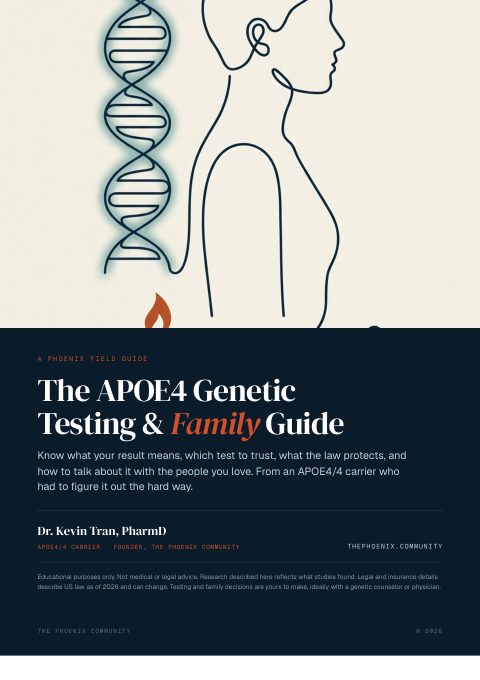 APOE4 Genetic Testing & Family GuidePrepare for testing decisions and family conversations.
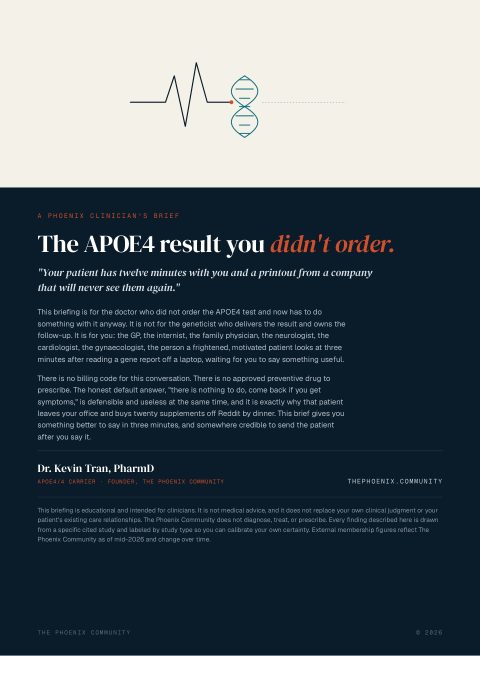 The Clinician’s APOE4 BriefBring a focused APOE4 reference into clinical conversations.
 The Doctor Conversation KitPrepare your questions and take a one-page brief to your appointment.
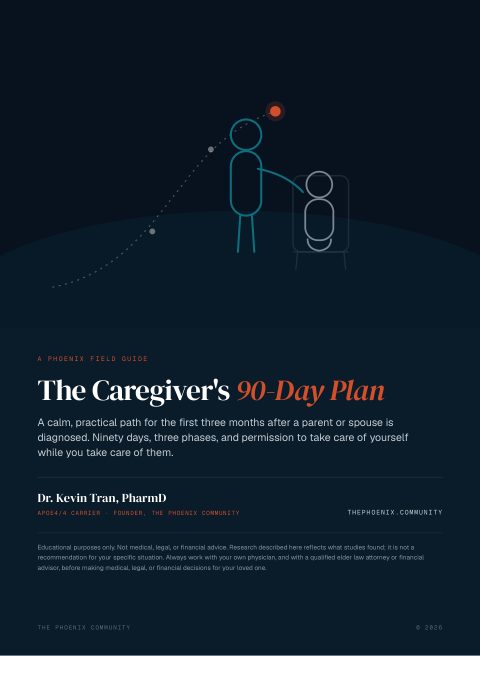 The Caregiver’s 90-Day PlanPlan the first months after a parent or partner is diagnosed.
Phoenix APOE4 ResearchClinical trial engineAPOE4 doctor directory