Free guide · 23andMe and AncestryDNA
Your raw DNA file already holds your APOE status.
Tested with 23andMe or AncestryDNA? Your APOE genotype may already be sitting in a file you can download. It comes down to two letters at two spots in your DNA. Once you have the file, it’s a search for two codes.
Finding them is the easy part.
Knowing what to do with the answer is harder. And reading it alone, at midnight, is risky without support.
So this guide comes with a free 5-email course: Got my result. Now what?
Free. Unsubscribe anytime.
rs429358
rs7412
Together, these two spots decide whether you carry APOE2, APOE3 or APOE4.
Step 1
Download your file
23andMe
Sign in, click your profile name at the top right, choose Resources, then “Browse Raw Genotyping Data”, then “Download”. Confirm your date of birth, tick the box and submit the request. 23andMe emails you when the file is ready. That usually takes about a week, and can take up to 30 days. The file arrives as a zip whose name starts with “genome”.
AncestryDNA
Open DNA Settings, choose “Download or Delete”, then “Download DNA data”. Confirm, and Ancestry emails you a link (it can take up to 24 hours). The link works once and expires after a week. Your file arrives as a zip.
Your file is sensitive. Open it on your own computer. You don’t need to upload it anywhere to read APOE.
Step 2
Search for two codes
Open the file in a text editor or a spreadsheet. Search for:
- rs429358
- rs7412
Together, these two spots decide whether you carry APOE2, APOE3 or APOE4. Each line ends with your two letters at that spot, for example CT.
No line for one of them? The chip that tested you didn’t read it. You can’t get your genotype from this file.
Tested with AncestryDNA? Read this first. Independent guides report that AncestryDNA files from 2017 on usually leave out rs7412, and that files from 2015 and 2016 may be wrong at these spots. SNPedia, the genetics wiki, goes further: it warns that Ancestry files have shown TT at rs429358 even for people whose other tests show they carry APOE4. So an Ancestry file can’t give you an APOE genotype you can trust. A reading that looks like “no APOE4” is not reassurance. Confirm with a test that reads both spots.
Step 3
Read your pair
| rs429358 | rs7412 | Your APOE genotype | Copies of APOE4 |
|---|---|---|---|
| TT | CC | 3/3 | 0 |
| TT | CT | 2/3 | 0 |
| TT | TT | 2/2 | 0 |
| CT | CC | 3/4 | 1 |
| CC | CC | 4/4 | 2 |
| CT | CT | usually 2/4 | usually 1 |
CT at both spots is the tricky one. It usually means 2/4. But a rare version of the gene gives the same letters, and the file can’t tell them apart.
Any other combination? Don’t guess. Get a clinical test.
Why it’s risky without support
Not because you can’t handle the truth.
Because of three things nobody tells you when you open that file.
- 1
The file can be wrong.
Consumer raw data is not a medical test. 23andMe’s own help centre says its raw data is “suitable only for informational use and not for medical, diagnostic, or other use.” In one lab study, 40% of the variants people brought in from consumer raw data turned out to be false positives. That study didn’t look at APOE. The lesson still holds: confirm before you act.
- 2
The answer can hit hard.
In a trial of 162 adults who had a parent with Alzheimer’s, learning their APOE result caused no significant short-term rise in anxiety or depression overall. But people who learned they carry APOE4 felt more test-related distress than people who didn’t. And people who were already very distressed before testing were more likely to struggle afterwards.
- 3
Some choices are hard to undo.
In the US, a law called GINA stops health insurers, and employers with 15 or more staff, from using your genetic information. It does not cover life, disability or long-term care insurance. Know that before your result lands in a medical record or on an insurance form.
And keep this in mind: APOE4 raises the risk of late-onset Alzheimer’s. It is a risk, not the disease itself. Not everyone who carries it develops Alzheimer’s.
What support looks like
What support looks like
A result you can trust.
A clinical-grade APOE test, through your doctor or a clinical lab. Here’s how to get tested for APOE4.
Someone to read it with you.
Your doctor or a genetic counselor. (Phoenix has a free brief for genetic counselors you can forward to yours.)
People who’ve been there.
Phoenix is the #1 APOE4 community optimizing their brain health: 750+ APOE4 carriers. 89% see improvement in key APOE4 biomarkers within 3 months (self-reported).
A plan for the next 10 days.
That’s the course.
Get the free course
Got my result. Now what?
Five short emails over 10 days. One job each.
- Day 0
What your result says (and what it doesn’t).
- Day 2
Check it before you believe it.
- Day 4
You don’t have to read it alone.
- Day 7
Your first week, one small step a day.
- Day 10
What other carriers learned that you can use.
I’m Kevin, a Doctor of Pharmacy, and I carry APOE4/4. This is the plan I wish someone had handed me the day I got my own result.
Sources
Sources
- Radmanesh F, et al. Accuracy of imputation to infer unobserved APOE epsilon alleles in genome-wide genotyping data. Eur J Hum Genet 2014. PMID 24448547. https://pubmed.ncbi.nlm.nih.gov/24448547/
- Tandy-Connor S, et al. False-positive results released by direct-to-consumer genetic tests highlight the importance of clinical confirmation testing for appropriate patient care. Genet Med 2018. PMID 29565420. https://pubmed.ncbi.nlm.nih.gov/29565420/
- Green RC, et al. Disclosure of APOE genotype for risk of Alzheimer’s disease (REVEAL). N Engl J Med 2009. PMID 19605829. https://pubmed.ncbi.nlm.nih.gov/19605829/
- MedlinePlus Genetics, APOE gene. https://medlineplus.gov/genetics/gene/apoe/
- National Human Genome Research Institute, Genetic Discrimination (GINA). https://www.genome.gov/about-genomics/policy-issues/Genetic-Discrimination
- Ancestry Support, Downloading DNA Data. https://help.ancestry.com/hc/en-us/articles/53933317283603-Downloading-DNA-Data
- 23andMe Support, Accessing Your Raw Genetic Data. https://support.23andme.org/hc/en-us/articles/42965156401687-Accessing-Your-Raw-Genetic-Data
- 23andMe Support, 23andMe and the FDA. https://support.23andme.org/hc/en-us/articles/42965034583063-23andMe-and-the-FDA
- SNPedia, APOE (archived copy of 7 Sep 2025; the live site blocks automated readers). https://web.archive.org/web/20250907131223/https://www.snpedia.com/index.php/APOE
- Genetic Lifehacks, Alzheimer’s and APOE type (updated 15 Oct 2026). https://www.geneticlifehacks.com/alzheimers-and-apoe-type/
- OutliveAPOE4, Find your APOE status in 23andMe (updated 16 Jun 2026). https://outliveapoe4.com/topics/find-your-apoe-status-23andme
Quick questions
Quick questions.
Does 23andMe already tell me my APOE status?
Maybe. If you bought 23andMe’s health reports, look for its Late-Onset Alzheimer’s Disease report. 23andMe says the FDA authorized that report in April 2017. Your raw file is a separate check, and both are worth confirming.
I got a different answer from another service.
Confirm with a clinical-grade test, and ask which two spots it read.
Is this medical advice?
No. This is education. Your doctor decides your care.
Get the free course
Got my result. Now what?
Five short emails over 10 days. One job each.
Free. Unsubscribe anytime.
More free guides.
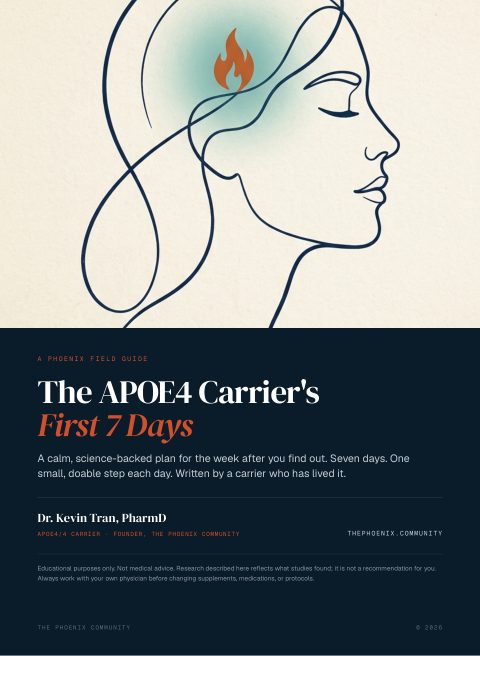 The APOE4 Carrier’s First 7 DaysA calm starting point for the questions after your result.
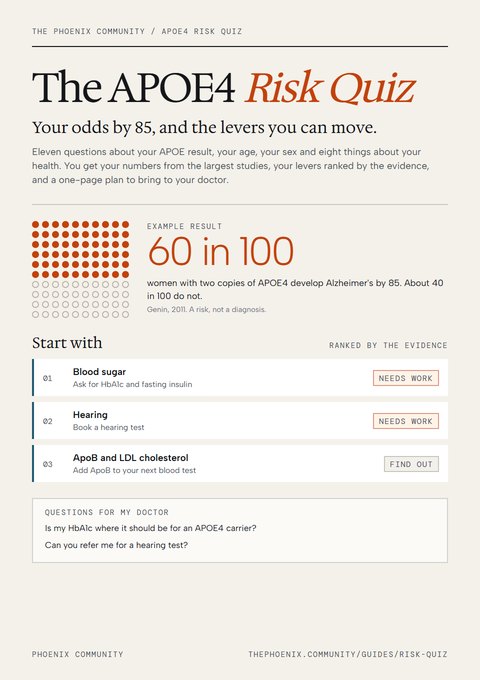 The APOE4 Risk QuizSee your numbers by 85 and the levers the evidence says matter most for you.
 The Essential Guide to Thriving with APOE4Explore daily choices and the evidence behind them.
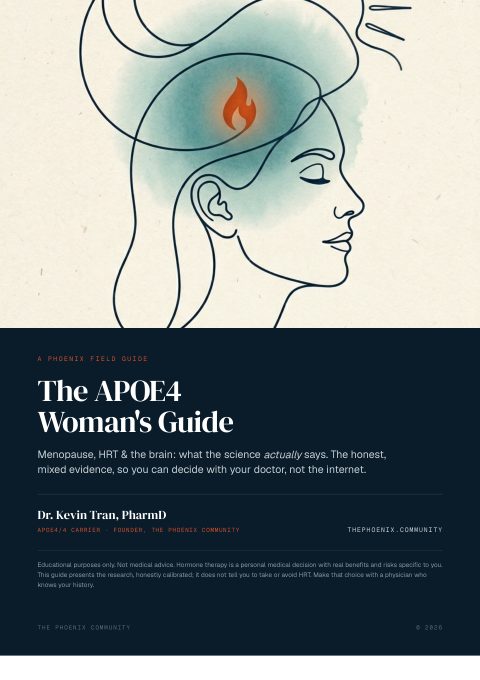 The APOE4 Woman’s GuideExplore menopause, hormone therapy and questions the evidence has not settled.
Phoenix APOE4 ResearchClinical trial engineAPOE4 doctor directory